




When police in Omaha agreed last month to stop carrying electric shock gloves in schools, a lot of parents learned for the first time what the officers in their children's hallways were carrying. Fewer could have said what those officers were there to do. That is the gap this piece fills.
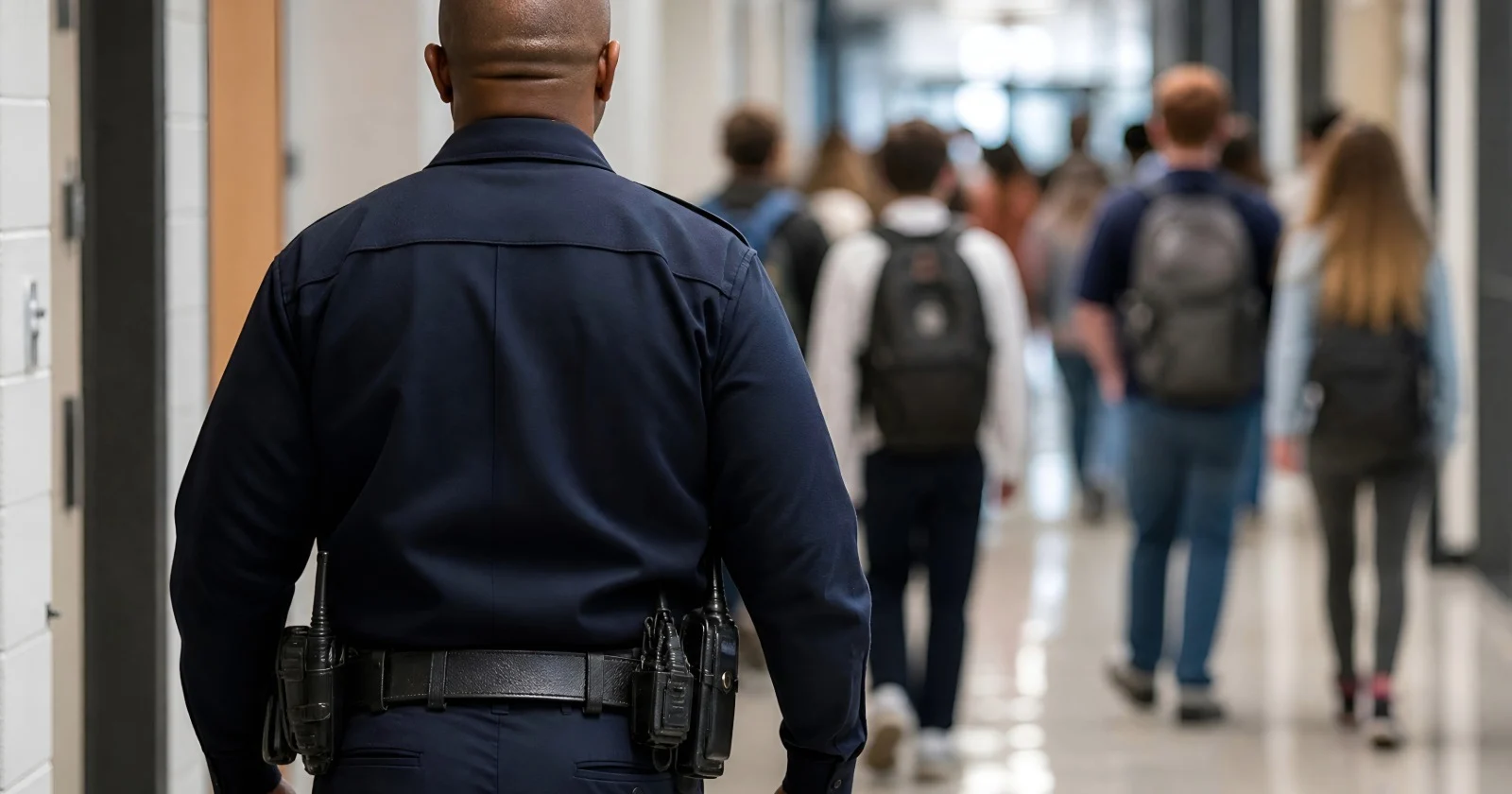
A school resource officer, or SRO, is a sworn police officer, with arrest powers and a badge, who is assigned to work inside a school. As of the 2024-25 school year, 53% of public schools reported having a sworn law enforcement officer present at least once a week, according to a federal school safety survey, a 5% increase from the year before. If your child attends a middle or high school, the odds are good there is one in the building.
Who the officer works for
An SRO is almost always an employee of a police department or sheriff's office, placed in the school through a written agreement with the district. The principal does not hire them, does not supervise them, and cannot fire them. The officer follows police department policy, carries police department equipment, and reports up a police chain of command.
That is why the Omaha case played out the way it did. The school district could ask the police department to stop using a device; it could not order it. The department agreed. A neighboring department, in Bellevue, declined, and its officers kept the gloves. We covered that split in our story on Nebraska's largest district and the shock gloves. The same structure means an SRO can carry a firearm, a stun gun, pepper spray, and a baton into a school even where the district would prefer otherwise, because those are police equipment decisions.
SROs are not the same as security guards
Schools use three kinds of safety staff, and families tend to lump them together.
School resource officers are sworn police with arrest authority, as described above. School police officers exist in some large districts that run their own police departments, such as Los Angeles or Houston; they are sworn too, but employed by the district itself. Security guards are usually district or contract employees without arrest powers. Their job is monitoring doors and hallways, de-escalating conflicts, and calling police when needed.
Nationally, security guards are more common than officers. Federal civil rights data counts roughly 30,000 full-time security guards in schools against about 22,000 SROs. The distinction matters in a crisis and in discipline: a guard who sees a fight breaks it up and reports it; an officer who sees the same fight can make an arrest.
What an SRO is supposed to do, and where the line blurs
The model most departments cite gives an SRO three roles: law enforcement, informal counseling and mentoring, and teaching, such as running safety or drug-awareness sessions. The law enforcement piece is meant to cover crimes and genuine safety threats, weapons, assaults, threats against the school.
What an SRO is not supposed to do is enforce school rules. Dress code, phone violations, talking back, skipping class: those are discipline matters that belong to teachers and administrators. Most district-police agreements say so in writing. The reason the line gets attention is that it blurs in practice, and when it does, an ordinary school discipline problem can turn into a criminal one. Research on school policing has found that students at schools with officers are more likely to be arrested for low-level offenses, and that Black and Hispanic students and students with disabilities are arrested at disproportionate rates, a pattern that shows up in federal discipline data more broadly and sits at the center of the long-running fight over race and school discipline.
Supporters of SROs point to faster response in emergencies, relationships that surface threats before they happen, and officers who become trusted adults for students who have none. Critics point to the arrest data, to the cost, and to evidence that officers do not reliably prevent the shootings they are often justified by. Both cases have real evidence behind them, and the outcome in a given school depends heavily on the officer, the training, and the agreement.
What to ask your school
Because so much depends on the local arrangement, the useful questions are specific. Ask whether the district has a written agreement, often called a memorandum of understanding, with the police department, and ask to read it. It should say what the officer's duties are, what they are excluded from, what equipment they carry, and how they interact with students with disabilities. Ask what training the officer has in adolescent development and de-escalation, since police academy training does not cover it. Ask how parents are notified if an officer questions their child, and whether a student can have a parent present. And ask what the data shows: how many arrests and referrals to police the school made last year, broken down by offense.
None of those questions are hostile. They are the questions the agreement is supposed to answer, and a school that has done this well will be able to hand you the document. If the answers are vague, that is worth raising with the board, and our guide to getting something done at a school board meeting covers how. For the broader picture of how schools handle safety and discipline, see what to do when your child is the one in trouble.
Sources
Bureau of Justice Statistics: School Resource Officers, 2019-2020
National Association of Secondary School Principals: School Resource Officers and Law Enforcement in Schools
Prevalence figures from the National Center for Education Statistics School Pulse Panel, 2024-25; staffing counts from the U.S. Department of Education Civil Rights Data Collection.