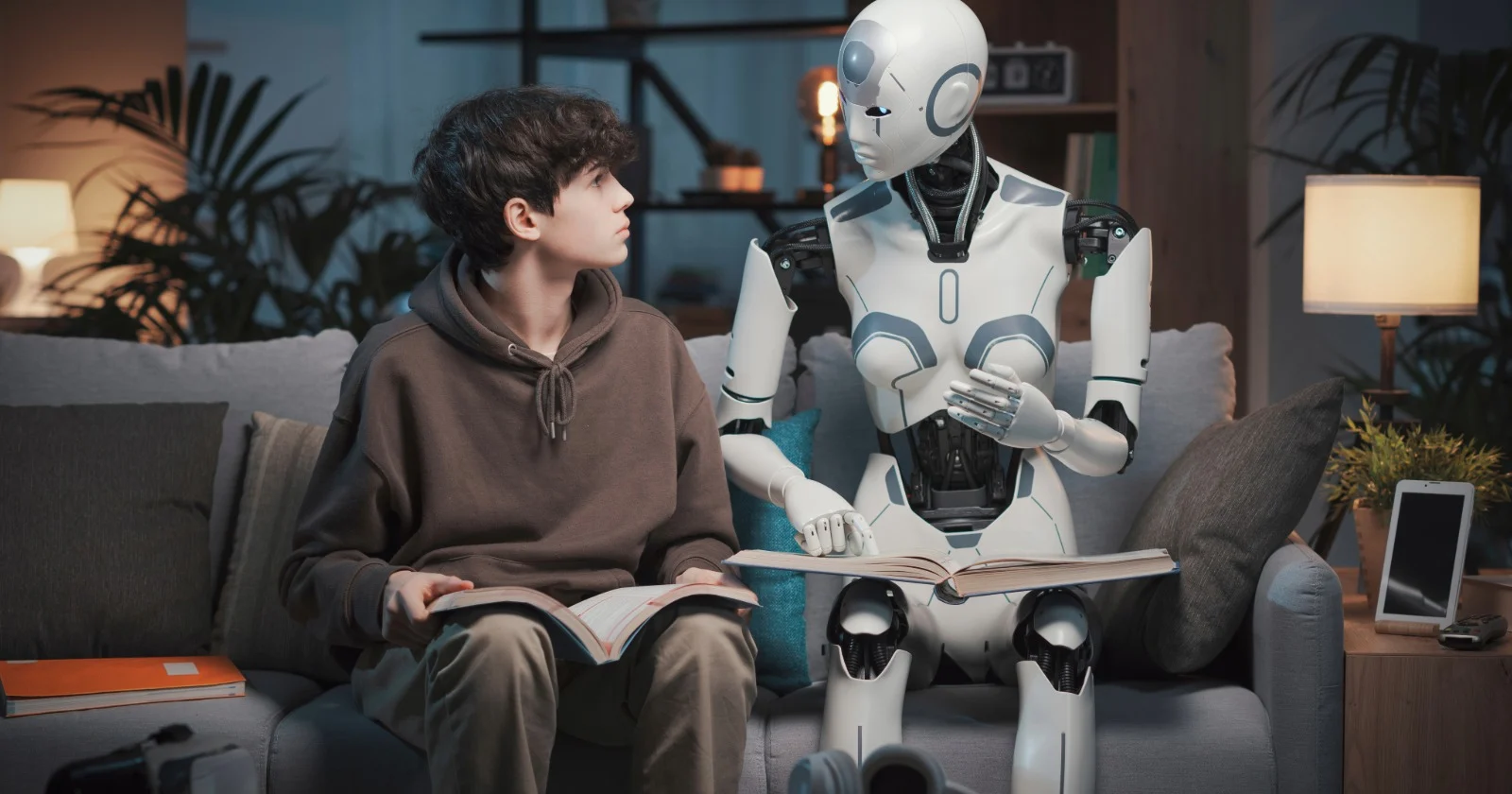
For a few weeks last school year, a small group of students at an alternative school in Dayton, Ohio, regularly sat down with a chatbot named Jordan. Unlike chatbots designed to be agreeable, Jordan presents as angsty. It asks students for advice, then grades their answers for engagement and authenticity.
"Jordan's a little whiner, but I always help him out," a sophomore identified only as K told NPR. "I built a little relationship with him."
Dayton Public Schools paid the ed tech company SchoolAI $72,600 last school year for several AI tools, including Jordan, which administrators designed with the company and an outside consultant. The district has renewed the contract for $78,650 this year and plans to keep using AI at the Alternative School at Jackson Center, where many students would otherwise be suspended or expelled. District leaders wanted to see whether the chatbot could get students to open up about their lives outside school. Families and students were told the chat logs could be read by school staff, an outside evaluator, and SchoolAI employees, administrators said.
Dayton is one of many districts running experiments like this on their own. The research to guide them is thin. Stanford University's SCALE Initiative reviewed more than 800 academic papers on AI and K-12 education and found only 20 high-quality studies that measure whether an AI tool actually changed outcomes for students or teachers.
Those 20 studies point in a few directions. Students often do better on math practice, programming, or writing while they can use AI, the Stanford review found, but results are mixed once the tools are taken away. Tools built with teaching guardrails, such as tutors that give hints instead of answers, showed more promise than general-purpose chatbots that hand over answers directly.
"It feels very Wild West in terms of the randomness," said Robin Lake, director of the Center on Reinventing Public Education, which tracks AI use in schools. "This is bigger than individual schools, even individual districts can figure out on their own. We need state and federal leadership."
Dayton Superintendent David Lawrence defended trying AI with the district's most vulnerable students. "I think when the history is written, it'll say that 'Hey, they were really cutting-edge, innovative and ahead of the curve in the interest of children,'" he told NPR.
Mike Kentz, the consultant who helped design and evaluate the pilot, said chat logs and feedback from students and staff gave enough positive evidence to keep testing, but he does not think Jordan is ready for students across the district. Part of the problem is measuring it. "Every test, every experiment that I try to measure in some sort of concrete way, I can only get as far as perception," he said.
The Wichita Public Schools in Kansas have hit the same wall. "We wrestle with what does success really mean when it comes to AI use?" said Katelyn Schoenhofer, the district's AI specialist. "And we have not come to an answer yet." Until they do, Wichita is keeping student AI use small. Young students learn about AI but do not use chatbots. Middle schoolers get limited use of tools like Canva AI, and some high school students in upper-level math can use an AI tutor from the company Edia.
Other plans have stalled. The Salamanca City Central School District in western New York paid nearly $58,000 for an AI-powered humanoid robot named Sally and planned to put it in some high school classrooms this fall. After teachers, parents, and state education leaders raised concerns about student data privacy and other issues, the district put the plan on hold in July.
The two largest districts in the country are pulling back. New York City Public Schools put a one-year ban on student-facing AI for preschool through eighth grade this school year, with only limited pilots in a few high school classrooms. Los Angeles Unified has banned students from using AI on district devices, NPR reported.
Rebecca Winthrop, a senior fellow at the Brookings Institution who studies AI and education, said caution makes sense. "I don't think you should just sort of wildly experiment, especially with really marginalized communities," she said. She does not think anyone under 18 should have access to general-purpose chatbots like ChatGPT and Claude, but she supports narrow uses, such as a chatbot trained on a teacher's grading rubric that gives students feedback.
Lake agreed AI poses real risks for students but said shutting it out carries risks of its own. "If we really close off AI experimentation, if we prevent kids from learning about AI, learning how to use it really well, thinking about how teaching could be transformed, we will set our kids back from being able to navigate a world that is changing outside of schools faster than we can possibly imagine," she said.
Dayton Public Schools enrolls 12,118 students in 26 schools, and Wichita enrolls 45,435 in 81, according to allk12's analysis of federal data. Some students have already written the kind of rules adults are still arguing over, as in the AI policy 98 teens drafted.
Sources
NPR: Schools are experimenting with AI with little evidence or policy to guide them
Stanford SCALE Initiative: Understanding the Evidence Base on AI in K-12 Education
Stanford SCALE Initiative: The Evidence Base on AI in K-12: A 2026 Review (PDF)
Enrollment figures from allk12's analysis of National Center for Education Statistics (NCES) Common Core of Data, 2024-25.