


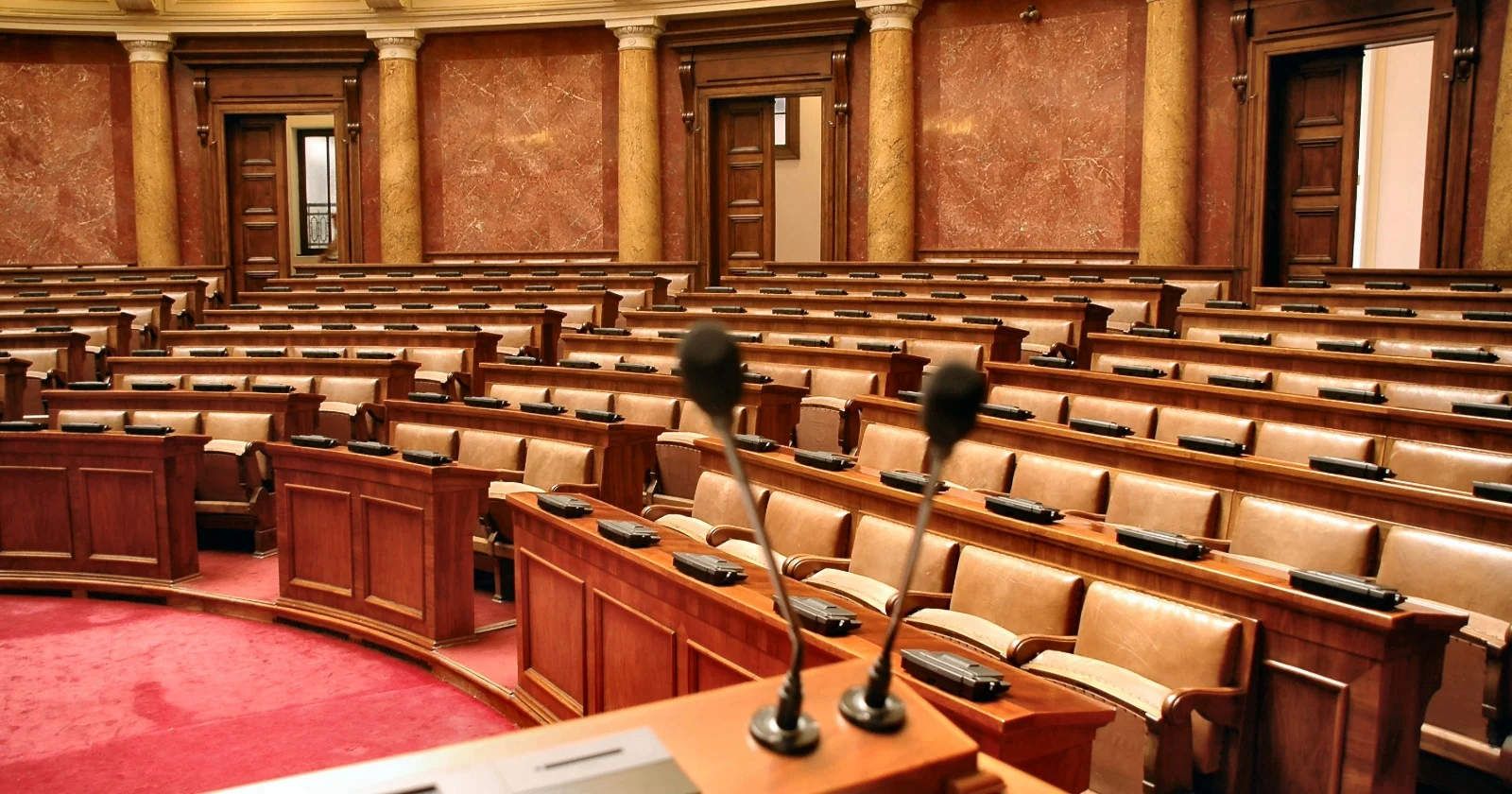
Ninety-eight high school students from all 50 states spent a weekend in late July doing something Congress hasn't managed: writing rules for artificial intelligence in schools. They met in a full-scale replica of the U.S. Senate chamber at the Edward M. Kennedy Institute in Boston, split into subcommittees, argued for two days, and passed a bill. You can view a stream of the session on YouTube.
They called it the Students First Act. It isn't law and they aren't senators. It might still end up shaping real policy, because the School Superintendents Association, one of the event's hosts, plans to send the text to its 10,000 members. A lot of those school leaders are writing their own AI rules right now with nothing federal to work from.
The other hosts were the Kennedy Institute and Day of AI, a nonprofit that grew out of MIT's RAISE initiative. Students were picked by their own school leaders. NPR covered the weekend from inside the chamber.
"The adults themselves haven't been able to come to consensus on this, right?" said Jeffrey Riley, Day of AI's executive director and a former Massachusetts education commissioner. "And so now it falls to the kids. Let them lead the way."
What's in the bill
The student section runs 15 provisions, including:
- Schools teach AI literacy as soon as students get classroom devices, covering misinformation, plagiarism, bias in AI design, privacy, academic use and AI's environmental cost.
- AI is banned on all graded tests.
- Students can't use AI for writing. Editing, brainstorming and studying are allowed after eighth grade.
- Students who do use AI have to cite how they used it and show they understand the material through discussion, handwritten tests or an oral defense.
- A student flagged for AI use gets reviewed by two school officials, not just by detector software.
AI detectors are not fully reliable, and a false positive can follow a kid around. The bill also tells teachers to personally investigate before sending anything to administrators.
Teachers get rules too. They can use AI for lesson planning, practice materials, feedback and improving instruction, and each semester they have to post a written policy saying when AI is allowed in their class and when it isn't.
What they argued about
The teens kept coming back to one worry: that their classmates are handing their thinking to a machine.
"Everyone's gonna stop learning and start relying on AI," said Campbell McHenry, a junior from Mississippi. "Instead of using it as a tool, they're gonna use it as a brain."
Several of them framed the whole weekend as a chance to avoid a repeat. "We missed the mark with social media and phones," said Hunter Wurzel, a senior from Ohio. He said the group kept returning to how badly adults handled teaching kids to use those tools.
The fight over when to start teaching AI ran into a wall that anyone who follows school funding will recognize. One California senator said requiring AI literacy would be a heavy lift because teachers are already under-resourced. Tristan Tjetjep of Tennessee asked how underprivileged schools would pay for it. The students settled it by writing in a federal funding requirement.
Their worry is measurable, and it's already showing up. RAND's American School District Panel found that by fall 2024, 67% of low-poverty districts had trained teachers on AI use, against 42% of middle-poverty districts and 39% of high-poverty ones. RAND's researchers put it plainly: low-poverty districts keep outpacing higher-poverty ones on AI training. The teens wrote a funding line into their bill because they suspected the gap existed. It does.
The chatbot fight
The sharpest exchange was about what a school chatbot should do if a student uses it for emotional support. Some students argued a kid who confides something about their sexuality or a mental health crisis should be able to trust it stays private.
Dylan Dornack of Iowa argued the other way from the floor. "This could be lifesaving," he said, "whether or not that student is fearful that they might get outed. This is just one of those things that has to be taken to trusted adults."
They landed on his side. Under the bill, a chatbot that detects a student in crisis doesn't answer the request. It alerts school officials.
The parent section gave them more trouble. An early draft let parents veto their child's AI access entirely, and the students cut it back. Tatiyana Reaves, a junior from North Carolina, said handing parents complete say would limit students, since plenty of adults don't know what AI is themselves. Isabella Stringer of New Hampshire put the limit on the whole section: "We cannot legislate parenthood." Most of those provisions ended up as suggestions.
How close it came
The bill nearly died. Ethan Liu of West Virginia spent part of the day opposing it, pointing out contradictions between amendments that restricted student AI access while handing teachers wide discretion.
"I thought it reflected really badly on us," Liu told the chamber. Organizers let the students fix some of the inconsistencies at the last minute, and he switched his vote, saying the bill was in much better shape.
More than half the students took a minute each at the microphone before the final vote. Most backed it.
The bill document posted to DocumentCloud, is titled "FINAL BILL PASSED 84-14" which you can view below.
Why superintendents care
There's no national policy on AI in schools, so the work has fallen to states and districts. Maryland put its districts on a deadline to adopt AI policies. Los Angeles Unified went at the problem from a different direction and capped student screen time. Most districts are somewhere in between, writing rules with no model to copy.
That's the gap the students filled. Their bill is nine pages, and it's public.
Sources
NPR: These teens wrote the AI school policy Congress hasn't
Full text of the Students First Act (DocumentCloud, 9 pages)
RAND: More Districts Are Training Teachers on Artificial Intelligence (Diliberti, Lake and Weiner, April 2025)
AASA, The School Superintendents Association