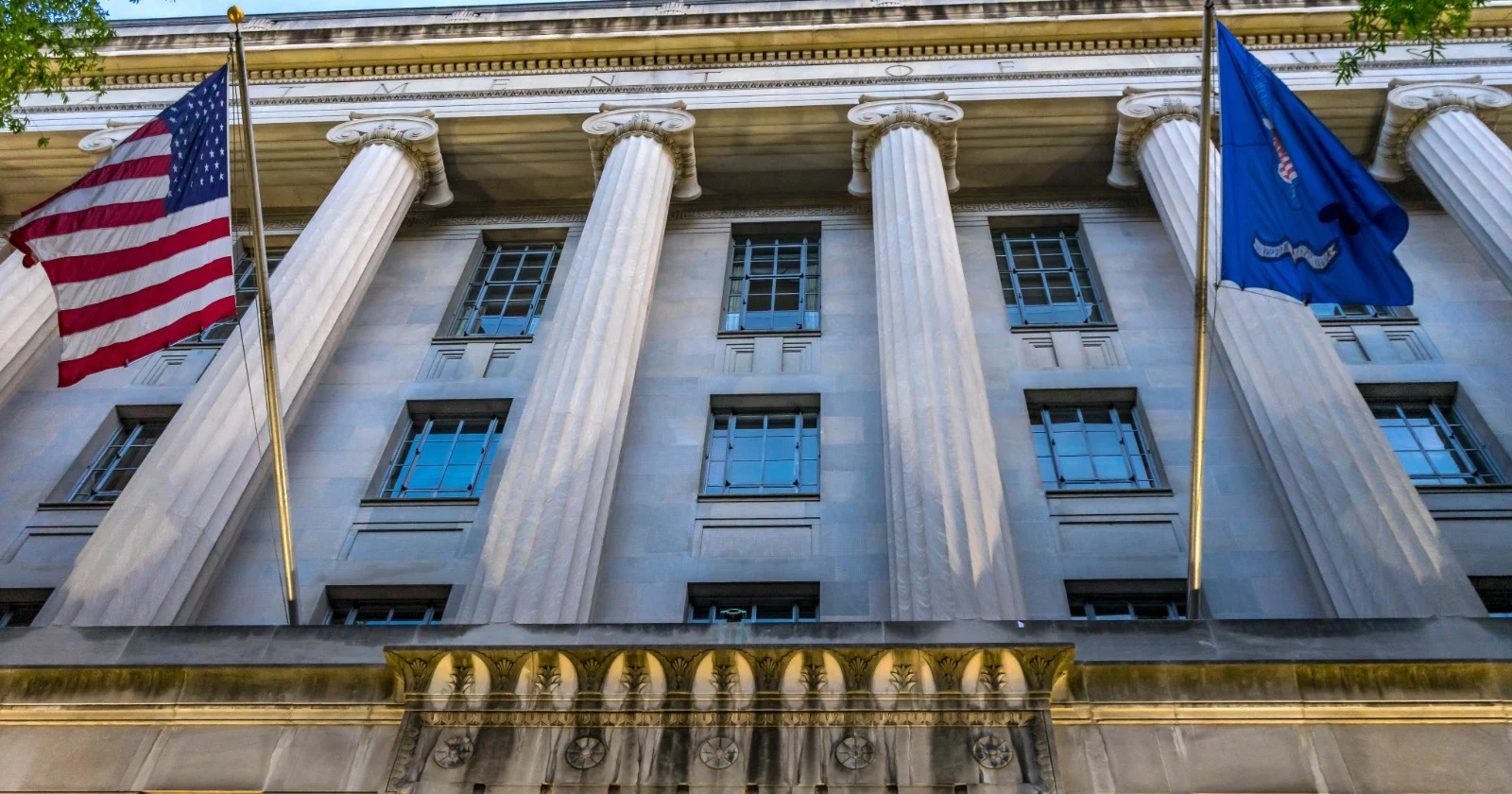
The Justice Department said November 5 that the federal Magnet Schools Assistance Program, as the Education Department now runs it, violates the Constitution's equal protection guarantee. The finding is a legal position from the executive branch. It is not a court ruling, and it does not end the program.
The 37-page opinion from the department's Office of Legal Counsel says the Education Department oversees 60 active magnet grants to school districts in 18 states. It said "the current program largely functions as a racial-balancing initiative." Some grants could theoretically pass constitutional review, the office wrote, "although we are not aware of any specific grant that currently does so."
The Education Department asked the question itself. Acting General Counsel Candice Jackson requested the opinion on July 24, and Deputy Assistant Attorney General Joshua Craddock signed it. The Office of Legal Counsel describes its core job as giving "controlling advice to Executive Branch officials on questions of law," so the opinion carries weight inside federal agencies. It is not a decision by a federal court, and Congress has not passed a new law, Magnet Schools of America noted in guidance to districts.
The statute versus how it is run
The opinion separates what Congress wrote from how the Education Department has carried it out. Magnet schools are public schools with a special curriculum meant to draw students of different racial backgrounds. The grant law's purposes include "the elimination, reduction, or prevention of minority group isolation" in schools with substantial proportions of minority students.
The office said that framework triggers strict scrutiny, the toughest test courts apply to government use of race. It also said the program is "not facially unconstitutional," meaning the law can still be applied legally in narrow cases. The office read the statute to allow grants only when a district is remedying a specific, identified instance of illegal discrimination and the award is narrowly tailored to that remedy. Grants based solely on goals such as more racial diversity, less racial isolation, or a different racial balance cannot be approved, the Justice Department said.
The office said the problem is sharpest for voluntary plans. When the Education Department made its request, 52 of the 60 grantees were running voluntary desegregation plans and 8 were under court-ordered plans. The opinion said "it may prove difficult for a voluntary desegregation plan today" to meet the test. The Justice Department has separately said it ended more than 50 older school desegregation cases.
The opinion names two awards as examples. Ypsilanti Community Schools in Michigan won $14,981,002 in 2023 after defining "Black student isolation" by comparing each school's Black enrollment with the share of Black residents in the district. Napa Valley Unified in California won $10,121,928 in 2017 and planned to recruit Hispanic and Latino students to one magnet school and non-Hispanic white students to others.
The office said districts' racial balancing strategies vary but stop short of admitting or rejecting students based on race. They include choosing school locations for likely racial effects, marketing to certain racial groups, and using lotteries designed to reach a desired racial balance. The office said it reviewed the department's implementation of the grants, not any specific school's policy.
The analysis leans on two Supreme Court decisions. Students for Fair Admissions v. Harvard (2023) struck down two universities' race-based admissions programs. Parents Involved v. Seattle (2007) found that two districts not under desegregation orders violated equal protection by using race to assign individual students. On October 19, the justices agreed to hear Association for Education Fairness v. Montgomery County Board of Education (No. 26-12), on what a plaintiff must show to challenge a race-neutral admissions policy as racially discriminatory.
Money, next steps, and the school count
Craddock said the program "can continue to serve students across the country" but "only if it is administered constitutionally." The Justice Department said it will work with the Education Department so awards comply.
Magnet Schools of America said the Education Department had not acted on the opinion when the group published its guidance. The group urged districts to consult lawyers and added, "Avoid premature changes." It said the opinion "does not challenge the constitutionality of magnet schools as a model of public education." After a December 2025 opinion from the same office on federal programs for minority-serving colleges, Education Secretary Linda McMahon said, "I agree with the Office of Legal Counsel opinion."
Grants run up to five fiscal years, and in the fiscal 2024 competition they could not exceed $15 million over that period, according to the Education Department. Its program page lists 19 new awards for fiscal 2024, the latest shown there, totaling $52,532,195 in year one and $253,337,550 over their expected terms. Congress provided $139 million for fiscal 2026, Magnet Schools of America said. The department lists $124.7 million for fiscal 2025, and its fiscal 2027 budget requests no money for the program, proposing to fold it into a new state grant called Make Education Great Again.
In September 2025 the Education Department moved to end magnet grants to New York City, Chicago, and Fairfax County over civil rights disputes that included policies on transgender students. A federal judge threw out the New York decision on April 8, 2026, finding the department skipped required Title IX steps. Chicago's lawsuit was dismissed after a settlement in August 2026.
allk12's school data does not include the federal magnet flag, so this count covers only operating public schools with "magnet" in their name. In 2024-25 that was 496 schools in 33 states, enrolling 260,008 students, according to allk12's analysis of federal data. The name match is only part of the total: the National Center for Education Statistics last reported 2,220,219 students in magnet schools in 2021-22, with California's data missing. White students made up 22.8 percent of enrollment at the 496 schools, compared with 43.0 percent at all other operating public schools.
| State | Schools with "magnet" in name | Enrollment, 2024-25 |
|---|---|---|
| California | 74 | 42,356 |
| Connecticut | 71 | 28,999 |
| Florida | 46 | 27,699 |
| Louisiana | 36 | 23,481 |
| Illinois | 27 | 14,049 |
Name match only, not a count of all U.S. magnet schools. White share is 59,143 of 259,948 students with reported race or ethnicity. Source: allk12 analysis of NCES Common Core of Data, 2024-25.
Sources
U.S. Department of Justice, Office of Legal Counsel: Whether the Magnet School Assistance Program Violates the Constitution's Equal-Protection Guarantee
U.S. Department of Justice: Justice Department Says Federal Education Aid Cannot Be Tied to Unconstitutional Race-Based Criteria
U.S. Department of Justice: Best Practices for OLC Legal Advice and Written Opinions
U.S. Department of Education: ESEA Part D, Magnet Schools Assistance
U.S. Department of Education: Magnet Schools Assistance Program awards
U.S. Department of Education: Fiscal 2024 Notice Inviting Applications
U.S. Department of Education: Fiscal Year 2027 Budget Summary
U.S. Department of Education: McMahon statement on Office of Legal Counsel opinion
Magnet Schools of America: Understanding the November 5, 2026, Department of Justice Opinion
Magnet Schools of America: Statement on the President's FY 2027 Budget Request
Supreme Court of the United States: Docket No. 26-12
U.S. Department of Justice: Justice Department Ends Over 50 Half-Century-Old Desegregation Cases
Bloomberg Law: Judge Nixes White House Plan Pulling NYC Magnet School Grants
Civil Rights Litigation Clearinghouse: Board of Education of the City of Chicago v. U.S. Department of Education
WTOP: Education Department withholds funds from Fairfax County schools
National Center for Education Statistics: Digest Table 216.20
School counts and enrollment from allk12's analysis of National Center for Education Statistics (NCES) Common Core of Data, 2024-25.