




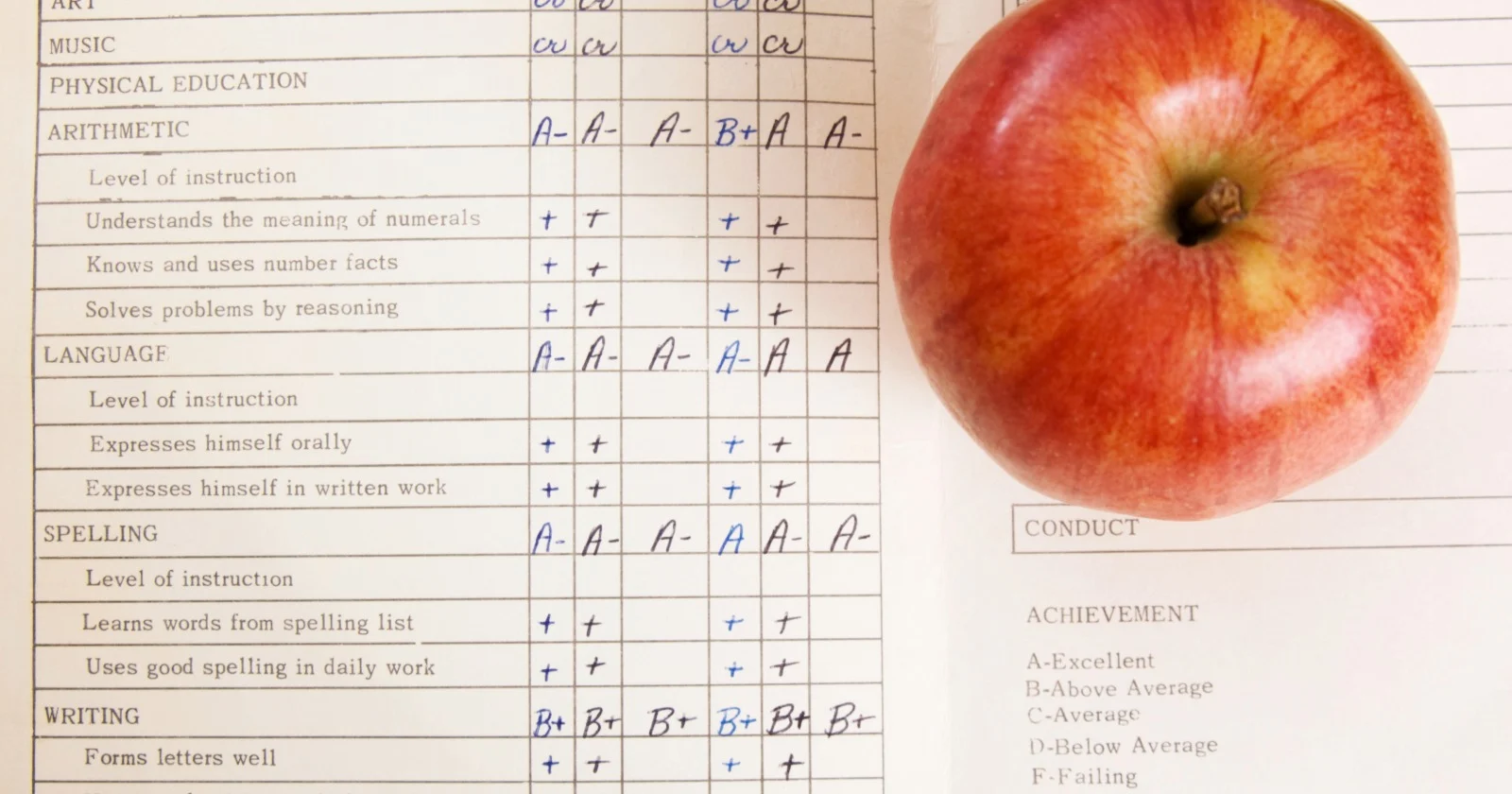
A parent opens the report card in October and finds a column of numbers where the letters used to be. Reading: 3. Writing: 2. Number sense: 3. Measurement: 2. No B, no C, no percentage, and no obvious way to tell whether this is good news. The instinct is to map it onto the old scale, where 3 out of 4 lands somewhere around a C, and to start worrying. That instinct is wrong, and the gap between what the parent reads and what the school meant is the whole reason for this piece.
That report card is using standards-based grading. Many elementary and middle schools have moved to it over the past decade, and the switch tends to arrive with a parent-night slideshow that explains the philosophy but not the practical question every parent has: is my kid okay, and how would I know from this page?
This is a companion to the broader debate over schools dropping letter grades. For the argument over whether the shift is a good idea at all, see why some schools are ditching A-F grades and why others are pushing back. Here I want to do something narrower: explain what the system is trying to measure, what the evidence supports, and how to read the thing in front of you.
What Standards-Based Grading Actually Reports
Start with what a standard is. A learning standard is a specific, named skill a student is expected to demonstrate at a given grade: "adds and subtracts within 100," "identifies the main idea in a text," "explains the water cycle." State standards documents break a year of school into dozens of these. Standards-based grading reports a separate mark for each one, or each cluster of them, rather than blending everything a child did all term into a single letter.
The mark is usually a number on a 1-to-4 scale, and the labels matter more than the digits. A common version reads:
- 1, beginning: the student is just starting and needs substantial support to show the skill.
- 2, approaching: the student is partway there and can do it with help or inconsistently.
- 3, meeting or proficient: the student has hit the grade-level standard. This is the target.
- 4, exceeding: the student is working beyond grade level, applying the skill in harder or more independent ways.
Read that scale again, because the third row is where almost all the confusion lives. A 3 is the goal. It means a child is doing exactly what the grade asks of them, on grade level, on time. It is not a near-miss on the way to a 4. The 4 is deliberately hard to get and is not the expected outcome for most students on most standards. Parents who came up through A-F see a 3 out of 4 and feel the pull of "75 percent, that's a C." The scale is not a percentage. A child earning 3s across the board is, in the school's terms, right where they should be.
The Design Choices That Make It Different
The 1-to-4 scale is the surface. Underneath it are several deliberate decisions that change what the grade represents, and these tend to surprise families most.
Academic mastery is separated from behavior. In a traditional gradebook, the B your child brings home is a blend: how much they know, how neat their work was, whether they turned it in on time, whether they participated, plus whatever extra credit they picked up. Standards-based grading pulls those apart. The academic mark reflects what the student knows and can do. Things like neatness, late submissions, participation, and effort get reported in a separate set of marks, often called work habits or learning behaviors. The point is that two different questions, "what does this child know" and "how responsibly does this child work," deserve two different answers rather than one number that hides both.
Recent learning counts more than early stumbles. Traditional grades usually average everything across the term, so a rough September can drag down a strong May. Standards-based grading favors the most recent demonstration of a skill, on the theory that what matters is whether the student can do it now, not whether they could the first week. A child who could not yet subtract with regrouping in October but has it solid by December is graded on December.
Reassessment is usually allowed. Because the question is whether the student has reached the standard, most systems let a student show the skill again after more practice and update the mark. A low score early is a snapshot, not a permanent dent.
Homework is practice. In many of these systems homework is for rehearsal and feedback, and it often is not graded for points at all. The reasoning is that practice is where mistakes are supposed to happen, so penalizing them confuses the picture of what a student has actually learned. This is often the choice parents find hardest to accept, and I will come back to it.
Why Schools Make the Switch
The case for standards-based grading rests on a single complaint about the letter grade: it blends things that should be kept apart. A traditional grade folds together knowledge, effort, behavior, and on-time submission into one symbol, and the recipe is different in every classroom. One teacher counts homework completion for 30 percent; another counts none. One allows extra credit; another forbids it. The result is that two students can both earn a B and know completely different amounts, because one knew the material and the other turned everything in on time and was pleasant in class. The letter is a real number, but it does not reliably answer the question parents and teachers think it answers.
Standards-based grading is an attempt to produce a cleaner signal of what a student actually knows. If neatness and lateness and participation live in their own columns, the academic mark is freed up to mean one thing.
This argument has a recognizable set of authors. Thomas Guskey has spent decades documenting how inconsistently teachers compute grades and arguing for separating achievement from behavior. Robert Marzano built much of the practical framework for scoring against learning targets on a proficiency scale. Ken O'Connor wrote the field's most-cited handbook of grading "fixes," including not averaging in early zeros and not using grades as punishment. Douglas Reeves is the source of the widely repeated argument against the zero on a 100-point scale, that a single missing assignment scored as a zero distorts an average far more than any other mark and can sink an otherwise-passing student. Whatever you make of the conclusions, the starting observation, that the traditional grade is a noisy mix, is hard to argue with.
The Criticisms, Taken Seriously
I think the diagnosis is largely right and the implementation is genuinely contested, and a parent deserves the honest version of both. The criticisms are not just nostalgia.
It does not travel to a transcript cleanly. This is the real one. College admissions still runs on GPAs and class rank, and translating a wall of 3s and 2s back into a single GPA is messy. Most high schools that use it convert to letters anyway, and the conversion rule is a judgment call that can advantage or disadvantage a student depending on how it is set. The system is most coherent in elementary and middle school and gets harder to sustain exactly where the stakes rise.
It can read as softer. To some parents and teachers, removing zeros, allowing retakes, and not grading homework feels like accountability draining out of the system. If a student can keep reassessing with no penalty and practice does not count, where is the consequence for not doing the work? Defenders have answers, the work-habits marks still capture responsibility and reassessment usually requires evidence of new practice first, but the worry that it lowers the floor on rigor is not irrational, and badly implemented versions of it do exactly that.
Four points is coarse. A 1-to-4 scale carries far less information than a 0-to-100 one. It cannot finely rank students, and it cannot distinguish a low 3 from a high 3. For families and systems that want gradation, that is a real loss, felt most when ranking actually matters.
It asks parents to relearn the report card. A grading system that the people receiving it cannot read is not doing its job, however sound the theory. The burden of translation lands on families, and a 3 that means "good" while looking like "75 percent" is a design that fights its own users.
And the evidence that it improves student outcomes is suggestive rather than settled. There is reasonable support for the underlying ideas, that separating behavior from achievement makes grades more accurate and that averaging in early zeros distorts them, but the body of rigorous research showing that switching a whole school to standards-based grading raises achievement is thin, and much of what exists is descriptive or small-scale. It is fair to say the reform is built on a sound critique of the old system; it is not fair to say it is proven to work better. Both things are true at once.
How to Read It as a Parent
Set aside the theory and look at the page. A few habits make the new report card legible.
- A 3 is good. It means on grade level, meeting the standard. Do not read it as a C. If your child is earning mostly 3s, they are where the grade expects them to be, and a sprinkle of 4s is a bonus, not the baseline.
- Read the trend, not the single early score. Because these systems weight recent learning and allow reassessment, a 2 in October on a skill the class just started is normal, not alarming. The question is which direction it moves by term's end. A 2 that becomes a 3 is the system working as designed.
- Check the behavior and work-habits marks separately. They are not buried in the academic score anymore, so you have to look for them deliberately. This is where you will find out whether your child is turning work in, staying organized, and participating. A child with strong academic marks and weak work habits is telling you something specific that a single letter grade would have blurred.
- Ask the teacher two concrete questions. First, which standards has my child not yet hit? Second, what does reassessment look like for those, and what should we do at home before the retake? Those two questions turn the report card from a verdict into a plan, which is what it is built to be.
If your school has just made this switch, the most useful thing you can do is resist the urge to translate the numbers into the grades you grew up with. They answer a narrower question than a letter ever did: not how is my child doing overall, but what specifically can my child do. That is a more limited claim, and once you read it as such, the column of 3s and 2s stops being a mystery and starts being a map. You can find your state's schools through the school directory if you want to see how your district describes its own approach.
Data note: descriptions of grading-scale labels and design conventions reflect the standards-based grading frameworks in common use across US public schools as of the 2025-26 school year; specific scales and policies are set locally and vary by district.
Sources
Education Week: What Is Standards-Based Grading, and How Does It Work?
Edutopia: Getting Started With Standards-Based Grading in Middle and High School
ASCD Educational Leadership: Breaking Up the Grade (Thomas Guskey)
University of Rochester Warner School: Standards-Based Grading History, Practices, Benefits, and Concerns
Thomas B. Fordham Institute: Standards-Based Grading Can Benefit Students in the Right Context