



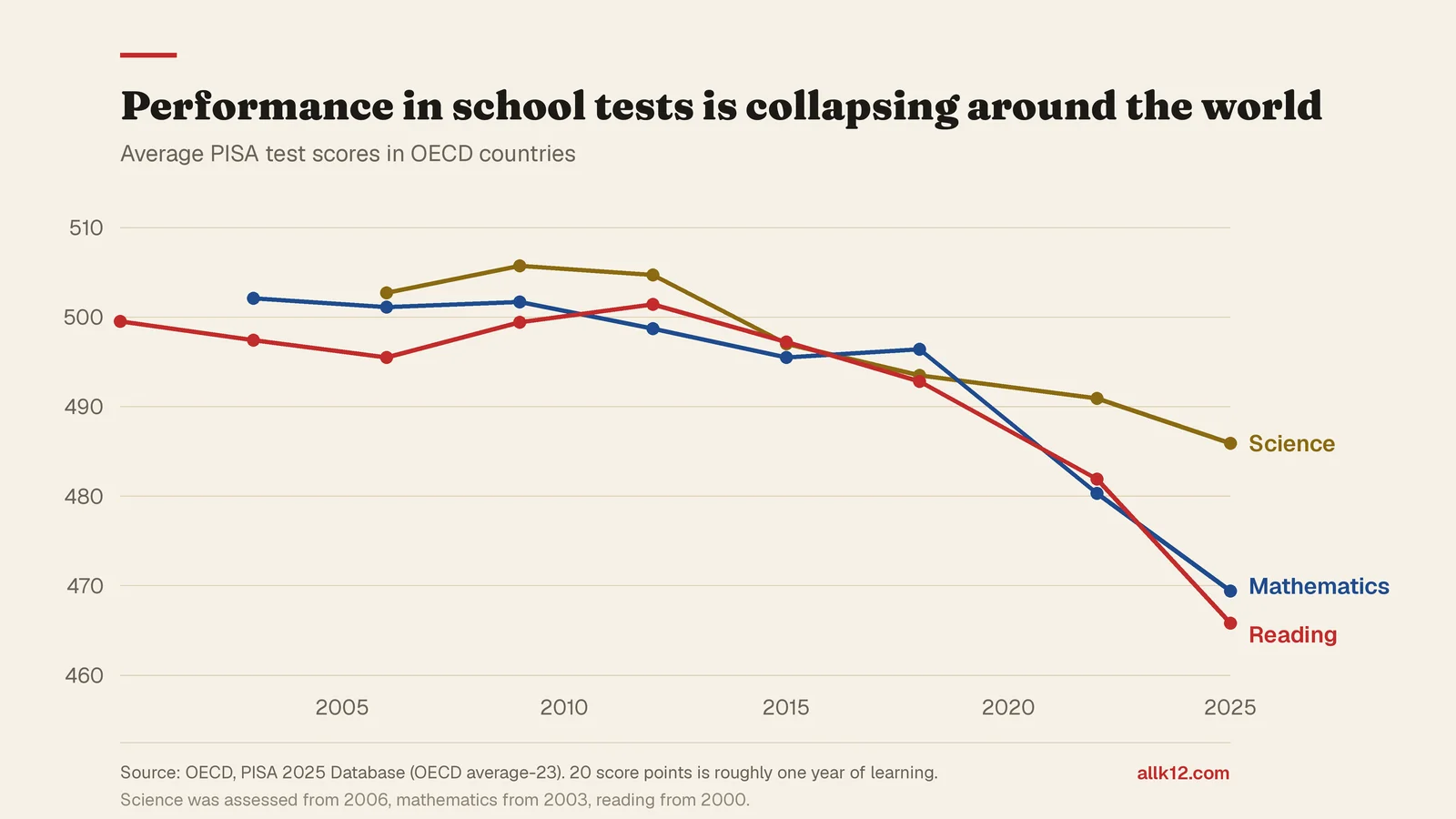
The OECD released PISA 2025 on September 8, and the results were the weakest the program has recorded. Average scores across OECD countries fell to record lows in both mathematics and reading, while 20% of 15-year-olds were low performers in science, math, and reading at the same time, up from 16% in 2022.
Reading fell 28 points across OECD countries between 2015 and 2025, which the OECD equates to about a year and a half of learning. Math fell 22 points, just over a year. Science held steady between 2022 and 2025 after sliding for more than a decade before that. The assessment covered 760,000 students in 91 countries, the largest PISA yet.
American results fit the pattern in one subject and not the others. US 15-year-olds averaged 490 in reading, down 14 points from 2022 and the lowest on record for the country, though still above the OECD average of 461. Math came in at 463, a two-point change that is statistically meaningless, and science at 502, essentially unchanged since 2006. One number stands out badly: the gap between the strongest and weakest American readers is now the largest of any country in the assessment. Education Secretary Linda McMahon called it "the largest performance gap between top-performing and bottom-performing students in reading anywhere in the world."
The US figures come with a warning label. The OECD flagged that the United States did not meet some of PISA's sampling standards, and said it could not rule out bias or determine whether the published scores overstate or understate real performance.
What PISA actually found about digital devices and distraction
Screen time is the first explanation people come up with for the lower scores, and this round of PISA gives it more support than previous ones did.
Students tended to perform worse when technology use became excessive, or when devices were used for leisure during the school day. Researchers described a curve rather than a line: limited or moderate use of technology for learning was associated with better outcomes up to a point, and past roughly three hours a day of classroom technology, performance started to fall across countries. Students reported spending about 1.7 hours a day on devices for learning at school, plus another hour for leisure while there.
The more interesting finding is about other people's phones. More than one in four students said classmates were distracted by digital devices in most or every science lesson. Those students scored lower, were less engaged, and felt less connected to their school. The cost of a distracted classroom does not land only on the student holding the phone, which is the argument districts have been making without this kind of evidence behind it. We covered both sides of that fight in whether phones should be banned in schools, and the aftermath of one ban in a North Carolina school that went through with it.
On artificial intelligence, PISA found that students who said they did not use AI to draft text for writing assignments outperformed those who did. Among frequent users, though, students who used AI to help them learn and were taught to judge the quality of what it produced did better than those given no guidance. That is why New York City is having a one-year ban on AI usage for younger students.
OECD Secretary-General Mathias Cormann framed it carefully. "Technology and AI can strengthen learning and help prepare young people for the future, but only when used purposefully and not as a substitute for attention, effort and understanding."
The part the global number hides
We compared 2024 and 2025 state test results for the same elementary and middle schools across the 30 states with data in both years, weighted by enrollment. Reading proficiency rose in 23 of those states and fell in 7. Math rose in 26 and fell in 4. The median state gained about 0.8 points in reading and 1.3 in math.
| Subject | States up | States down | Median change |
|---|---|---|---|
| Reading | 23 | 7 | +0.8 points |
| Math | 26 | 4 | +1.3 points |
Those are small gains, and a few of the largest movers almost certainly reflect a changed test or a changed cut score rather than better teaching, which is why the median matters more than the leaders. Pennsylvania reading fell 4.7 points, the steepest drop in the group. But the direction is the opposite of collapse, and it holds across most of the country.
The long-term NAEP found the same split from a different angle. Nine-year-olds are back near pre-pandemic reading performance and improving in math, with the lowest performers gaining the most. Thirteen-year-olds read about the same as their counterparts 50 years ago, and their math scores fell 15 points between 2012 and 2025.
So the collapse has an age. PISA tests 15-year-olds. NAEP's worst results are among 13-year-olds and high school seniors. Our state data, which covers elementary and middle grades, points upward.
That pattern is consistent with the phone explanation, since device saturation arrives with adolescence. It is equally consistent with the pandemic explanation, since today's 15-year-olds lost fourth and fifth grade and today's 9-year-olds were in preschool. Lesley Muldoon of the National Assessment Governing Board put the open question plainly, asking what is fueling the upward trends in the elementary years and why they are not happening among older students.
Reading the numbers on your own child's report is a smaller problem with a clearer answer, and we walk through it in how to read your child's state test scores. The OECD will publish further PISA analysis in 2027.
Data note: state comparison reflects allk12's analysis of school-level state assessment results for 2024 and 2025, restricted to elementary and middle schools present in both years with reported enrollment, weighted by enrollment, for the 30 states with at least 100 matched schools. Scores are not comparable between states, which use different tests and different proficiency standards; only each state's own year-over-year change is meaningful. High schools are excluded because state proficiency reporting at that level is not comparable across years.
Sources
OECD: PISA 2025, Students' reading and mathematics performance declined sharply across the OECD
K-12 Dive: From science to screen time, 4 key takeaways from the latest PISA results
Chalkbeat: New NAEP scores show promise for younger students, but teens are struggling
State assessment figures from allk12's analysis of school-level results reported by state education agencies.