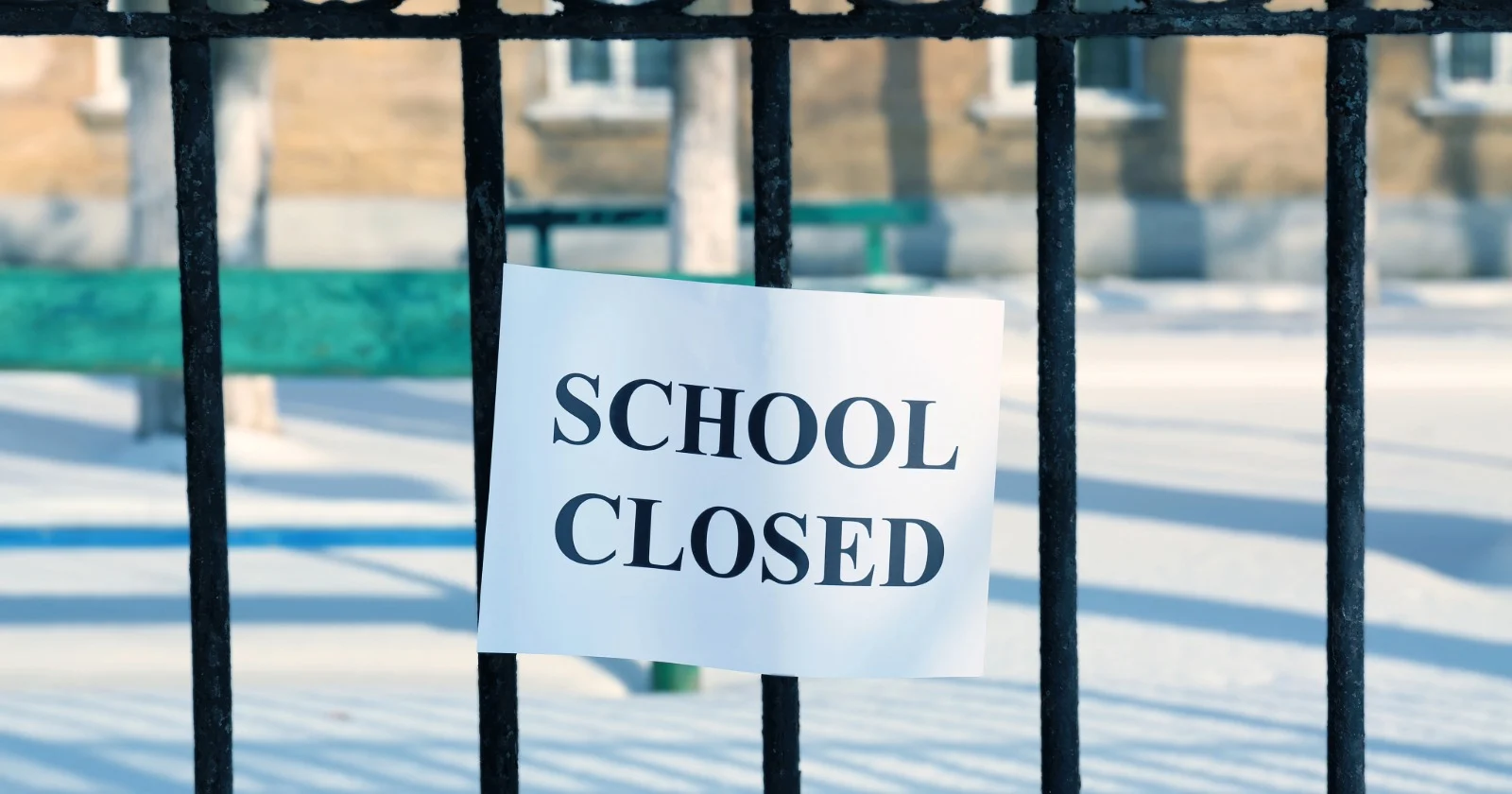



Schools are closing mainly because there are fewer children to fill them. U.S. births peaked in 2007, more families now pick charter schools, private school choice programs, or homeschooling, and districts paid largely by enrollment are left heating, staffing, and repairing buildings that are far from full.
Of the 95,397 public schools operating in fall 2019, 3,386 had closed by fall 2024, according to allk12's analysis of National Center for Education Statistics (NCES) data. Public schools had 1,419,064 fewer students over the same five years, a 2.8% drop, as detailed in allk12's report on closures since the pandemic. The table shows when those schools closed.
| Federal directory year | Schools first listed as closed | Charter schools | Other public schools |
|---|---|---|---|
| 2020-21 | 725 | 162 | 563 |
| 2021-22 | 591 | 80 | 511 |
| 2022-23 | 599 | 97 | 502 |
| 2023-24 | 705 | 130 | 575 |
| 2024-25 | 766 | 115 | 651 |
| Total | 3,386 | 584 | 2,802 |
Source: allk12 analysis of the NCES Common Core of Data school directory, fall 2019 to fall 2024, 50 states and DC. A school counts as closed if it operated with students in fall 2019, NCES later marked it closed, it was not operating in fall 2024, and no new ID number took over its name in the same city. The year is the first directory that listed it as closed. Charter schools are publicly funded but run independently of a school district.
Closures rose each year after 2021-22, from 591 to 766. Charter schools closed at more than twice the rate of other public schools: 584 of 7,489 charters, or 7.8%, against 2,802 of 87,908 other schools, or 3.2%. The federal status codes don't say whether a closed school merged into another one, so consolidations count as closures. Closure votes in Houston, Philadelphia, and Pittsburgh are covered in allk12's look at closures rising nationwide.
Fewer children, and more of them elsewhere
The National Center for Health Statistics counted 4,316,233 U.S. births in 2007, the all-time high. Its final data for 2024 show 3,628,934 births, which is 687,299 fewer, or 15.9% below the peak. The general fertility rate, births per 1,000 women ages 15 to 44, hit a record low of 53.8 in 2024 and has fallen 21% since 2008. Provisional figures for 2025 show 3,606,400 births and a rate of 53.1.
Births fell 6% from 2014 to 2019 and another 4% from 2019 to 2020, according to the same 2024 report. Each smaller birth year reaches kindergarten about five years later and then moves up through the grades. The Western Interstate Commission for Higher Education (WICHE) projected in 2024 that U.S. high school graduates would peak in 2025 and fall 13% by 2041, tied to "fewer births 18 years prior."
Districts that are closing schools say the same. Poudre School District in Fort Collins, Colorado, says, "Birth rates are down and fewer young families are moving into our attendance area." Boulder Valley School District lists "dwindling birth rates and an aging population."
Enrollment has also shifted between kinds of schools. Charter enrollment rose from 3,432,583 in fall 2019 to 3,950,158 in fall 2024, up 15.1%, while enrollment at all other public schools fell 4.1%, from 47,020,528 to 45,083,889, according to allk12's analysis of NCES data. EdChoice, a group that backs school choice, counted more than 1.5 million students in 75 private school choice programs across 34 states, DC, and Puerto Rico as of December 2025. In its February 2026 rankings, Florida's largest program had 280,611 students and Arizona's education savings account program, which gives families public money for private school and other costs, had 96,802. EdChoice's counts don't show how many of those students left public schools.
Texas started its education savings accounts this school year. As of August 10, 2026, 118,441 students had been awarded Texas Education Freedom Accounts for 2026-27, and 30% of them had attended a public school in 2024-25, according to the Texas Comptroller's office. Killeen ISD spokeswoman Karen Rudolph pointed to falling birth rates, changing demographics, and options including charter schools, private schools, homeschooling, virtual learning, and the state's new voucher program.
Homeschooling is still growing, but more slowly. In the 22 states that had reported 2025-26 counts, homeschooling grew 1.5%, or about 9,000 students, after growing 6.3% the year before, according to the Johns Hopkins Homeschool Hub. Those are counts registered with states, which the Hub treats as a minimum because not every family reports.
Slower immigration is the newest factor. "To stop or slow immigration really exacerbates those problems," said Stanford University economist Thomas Dee, who studies education policy. Los Angeles Unified board member Kelly Gonez said enrollment losses worsened after immigration raids escalated in the city in 2025. "We were predicting a 2% drop in enrollment. It was double that," Gonez said.
Money and empty buildings
A June 2026 brief from Bellwether and WestEd explains why fewer students becomes a budget problem: "When funding formulas are based primarily on student counts, revenues can disappear faster than expenditures can adjust." The authors estimated that public schools could lose $11.5 billion a year in state revenue by 2030-31 compared with 2025-26, and that federal projections show 40 states and DC losing more students by then.
Federal pandemic aid has also run its course. Congress gave schools $190.3 billion through the Elementary and Secondary School Emergency Relief (ESSER) fund, according to the Congressional Research Service, and the largest round, $122.8 billion, had to be committed to specific uses by September 30, 2024.
Killeen ISD says, "School buildings still need electricity, water, maintenance and repairs, whether classrooms are full or partially empty." It also expects to lose about $31 million a year in federal Impact Aid, which follows students from military and federal families. Poudre adds about $8.4 million a year to the budgets of 33 schools that are too small to fund a full staff through its per-pupil formula, the district says. Many buildings also need major work. In a 2020 report, the Government Accountability Office estimated that 54% of districts needed to update or replace multiple building systems, and that about 36,000 schools needed heating, ventilation, and air conditioning updates.
The districts closing schools describe a lot of empty space. St. Louis Public Schools counted 1,473 students in September 2025 at the nine schools its board voted to close on November 10, in buildings with room for 3,748, so they were about 39% full. North East ISD in San Antonio, which voted November 16 to close three elementary schools, counted 232 students at Montgomery Elementary in a building with capacity for 968, or 24%. Killeen counts about 6,100 empty elementary seats. Poudre says it has "roughly 10,000 more seats than students," and Boulder Valley's elementary schools, not counting charters, were 67% full in 2025-26, with 4,811 open seats. Both Colorado districts approved closures this fall, as allk12 covered in its look at five districts and the parents fighting closures.
Of the schools on the St. Louis list, board president Karen Collins-Adams said "several of them do have an extremely low enrollment." North East ISD Chief Financial Officer Susie Lackorn said in October, "we have shrunk by 17,000 kids since our peak." Poudre Superintendent Brian Kingsley said, "Every year that we have protected buildings, we have done it by asking teachers and staff to do more with less."
Housing costs come up in Colorado. Boulder Valley lists "the high cost of living in BVSD," "low housing inventory due to people aging in place," and "more affordable housing opportunities in surrounding districts" among its reasons, and Poudre cites higher living costs. Killeen says new homes in its area have not always meant more students in its schools.
Colorado ranks fourth by the share of its schools that closed, at 6.0%. Texas closed the most schools, 416, or 4.7% of its fall 2019 total.
| State | Schools closed | Schools open, fall 2019 | Share closed | Share closed, excluding charters |
|---|---|---|---|---|
| Minnesota | 189 | 2,324 | 8.1% | 7.9% |
| Louisiana | 93 | 1,342 | 6.9% | 5.4% |
| Mississippi | 58 | 886 | 6.5% | 6.6% |
| Colorado | 114 | 1,909 | 6.0% | 5.6% |
| Arkansas | 59 | 1,053 | 5.6% | 5.3% |
| Wisconsin | 122 | 2,232 | 5.5% | 4.3% |
| Ohio | 179 | 3,447 | 5.2% | 4.7% |
| Tennessee | 94 | 1,822 | 5.2% | 4.1% |
| Rhode Island | 15 | 309 | 4.9% | 4.8% |
| Florida | 188 | 4,004 | 4.7% | 3.8% |
| United States | 3,386 | 95,397 | 3.5% | 3.2% |
Source: allk12 analysis of the NCES Common Core of Data school directory, fall 2019 to fall 2024. The 10 states with the highest share of their fall 2019 schools closed by fall 2024; closures follow the definition in the first table. Mississippi had no charter schools close, so its share excluding charters is slightly higher. Hawaii had no closures.
The federal count stops at fall 2024, so it doesn't include the St. Louis, North East ISD, Poudre, and Boulder Valley closures approved this fall, which take effect in 2027 or later.
Sources
National Center for Health Statistics: Births: Final Data for 2024
National Center for Health Statistics: Recent Decline in Births in the United States, 2007-2009
National Center for Health Statistics: U.S. Births down 1% in 2025
WICHE: Knocking at the College Door, 11th edition
EdChoice: The 2026 ABCs of School Choice Is Available Now
EdChoice: 2026 EdChoice Participation Rankings
KPRC Click2Houston: 70% of Texas voucher awardees previously attended private school or were homeschooled, state data shows
Killeen Daily Herald: As enrollment drops, Killeen ISD reveals plan that may close more schools
Johns Hopkins Institute for Education Policy: Homeschool Growth, 2025-2026
NPR via KUNC: Low birth rates were emptying public schools. ICE deportations are now making it worse
Bellwether and WestEd: Declining Enrollment in America's Public Schools, June 2026
Congressional Research Service: Education Stabilization Fund: Expenditures for Elementary and Secondary Education
GAO: School Districts Frequently Identified Multiple Building Systems Needing Updates or Replacement (GAO-20-494)
Killeen ISD: Enrollment Drops by 5,000+ Students in Three Years
Poudre School District: Comprehensive Planning in PSD
K-12 Dive: Fort Collins-area district to close, consolidate 8 schools
Boulder Valley School District: Resilient Schools
St. Louis Public Schools: School Data Sheets for Future Ready Planning, Summer 2026
KMOV: St. Louis Public Schools to close 9 buildings next school year
North East ISD: Efficiency Committee update, October 19, 2026
Texas Public Radio: Three North East ISD schools on the short list for possible closure in 2027
School closure and enrollment figures from allk12's analysis of National Center for Education Statistics (NCES) Common Core of Data school directory, fall 2019 to fall 2024, via the Urban Institute Education Data Portal.