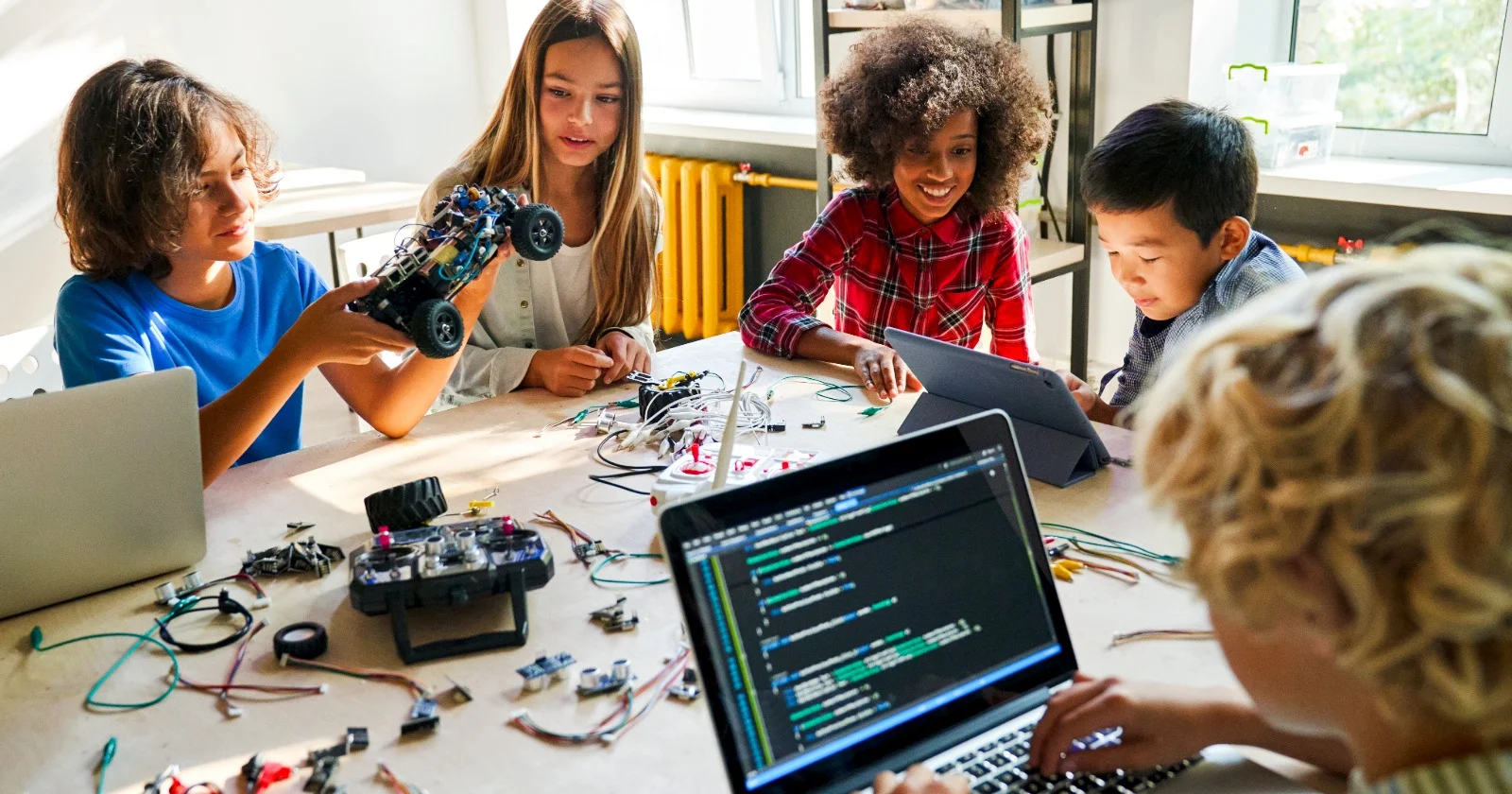
On a weekday afternoon in Austin, a group of nine-year-olds is not sitting in rows practicing for a state test. They are running a small pretend business, arguing about pricing, and being coached on how to give a two-minute pitch. The morning academics were done by lunch, powered by software rather than a teacher at a whiteboard. This is Alpha School, and versions of this scene are showing up in more affluent neighborhoods across the country. The families choosing it are not fleeing failing schools. Many are leaving well-regarded ones.
Something is shifting in how high-earning families think about K-12. The pandemic cracked the assumption that school means a building, a bell schedule, and thirty kids per adult, and a slice of parents with the money and time to experiment walked through that crack and did not come back. What they are building instead, with the help of software, venture capital, and in some states public money, is worth examining carefully. The trend is real. The evidence that it works is not.
The Homeschooling Surge That Never Fully Receded
According to the Census Bureau's Household Pulse Survey, the share of U.S. households with school-age children that reported homeschooling rose from 5.4% in spring 2020 to 11.1% by that fall. That is a doubling in a single season, and it was not evenly spread. Massachusetts jumped from about 1.5% to 12.1%. The rate among Black households rose roughly fivefold.
Most observers expected the numbers to snap back once mask mandates lifted and buildings reopened. They did not, at least not all the way. Reporting on district-level enrollment through the 2022-23 year found homeschooling largely holding its pandemic gains, and federal survey data put the homeschooled population at roughly 2.5 million students in 2019 and closer to 3.1 million by 2021-22. Growth has continued at a pace well above the pre-pandemic trend. Homeschooling stopped being a fringe choice and became a standing option that a meaningful number of families keep picking.
Once a family decides the default school is optional, the question becomes what to do with the freed-up time and money, and that is where the newer models come in.
Microschools and Learning Pods Go From Improvisation to Industry
A few families would hire a tutor or take turns supervising a handful of kids around a kitchen table. What surprised a lot of people is that many of those arrangements formalized into microschools instead of dissolving. A microschool is small by design, often 15 or fewer students of mixed ages, typically pairing adaptive software with a single adult guide. It is not a charter school, which is publicly funded and state-authorized. If that distinction is fuzzy, we walk through it in our explainer on what a charter school is and how it differs from a public school.
The National Microschooling Center estimates there are now roughly 95,000 microschools and pods nationwide, serving more than a million students when part-time learners are counted. That figure is a sector estimate rather than a hard census, and it deserves the caution any self-interested trade group's numbers deserve, but even a fraction of it describes a category that has moved past improvisation. Named networks now run at scale. Prenda has spread to hundreds of sites since starting with a single school in 2018. KaiPod, Primer, and Sora have raised real money, with venture funding reported in the range of $18 million for Primer, $45 million for Prenda, and $23 million for Sora. Sora Schools, an online option, charges around $12,900 a year. KaiPod tuition runs roughly $8,000 to $15,000. These are businesses now, with investors who expect growth.
When a school model has to satisfy venture backers, the pressure to scale can pull against the small, personal setting that was the selling point in the first place.
The AI School as the Trend's Sharpest Edge
If microschools are the broad category, AI-driven academies are its most attention-grabbing version, and Alpha School is the flagship. Its pitch is compact enough to fit on a bumper sticker: two hours of academics a day. Students work through adaptive apps for math, reading, and science each morning, moving at their own pace, while adults called guides handle motivation and supervision rather than direct teaching. The afternoons go to what the school calls life skills. Financial literacy, public speaking, entrepreneurship, real-world projects.
Alpha started in Austin and, as of early 2026, operates around 13 campuses across Arizona, California, Florida, New York, Texas, and Virginia, with reporting pointing to plans for more than a dozen additional cities. Tuition typically sits near $40,000 a year and ranges up to $75,000. One clarification the founders themselves make is worth flagging, because the marketing language blurs it: the "AI" in these classrooms is mostly adaptive learning software of the kind that has existed for years, closer to Khan Academy or IXL than to a chatbot tutor. That distinction will matter when we get to the evidence.
The through-line across Alpha, Synthesis, and the microschool networks is a bet about time: that conventional school wastes hours on pacing built for the middle of the class, and that software can compress the core academics so children can spend the rest of the day on things a test never measures. It is a genuinely appealing idea. Whether the compression works as advertised is a separate question.
Why This Looks Like an Affluent Trend
Look at the price tags again. $40,000 for Alpha. $12,000 or $13,000 for the online options. Even a modest microschool has to cover a building and an adult's salary across a dozen families, which one operator estimated at $85,000 to $100,000 a year to run. These are not costs that a median-income family absorbs casually. For most of its history, this whole category has been something you buy, which means it has mostly been bought by people with money.
That is starting to change at the edges, and the mechanism is public policy. A wave of universal Education Savings Account programs now routes state education dollars to families to spend on approved private options, including some microschools and homeschool expenses. By early 2026, Arizona, Arkansas, Florida, New Hampshire, and West Virginia had made these accounts universal in both eligibility and funding. Florida's program is the largest, with more than 220,000 participants in 2024-25.
On paper, ESAs could broaden access. In practice, the early data complicate that story. A Brookings analysis of Arizona's universal program found that participation skewed sharply toward wealthier areas: roughly 74 recipients per 1,000 children in the highest-income neighborhoods versus about 20 per 1,000 in the lowest-income ones, with a similar gap by parental education. The authors concluded that nothing in the pattern suggested the program was closing gaps in school access. A subsidy that flows disproportionately to families who were already going to opt out is a real policy outcome, not a hypothetical one.
What the Life-Skills Emphasis Is Actually Reacting To
It is worth taking the life-skills argument seriously rather than dismissing it as marketing. The parents choosing these schools are often reacting to something specific: a sense that conventional K-12 spends too much of a child's day on test preparation and too little on the competencies that adults actually use. Managing money. Speaking in public without freezing. Starting and finishing a project that no rubric fully describes.
There is a balanced version of this critique and an overstated one. The balanced version notes that many public schools, under accountability pressure, did narrow toward tested subjects, and that a school with two structured hours of core academics can genuinely free time for other things. The overstated version assumes that financial literacy at nine or a pitch competition substitutes for the slow accumulation of knowledge that makes later learning possible. This touches a broader debate we have taken up in our look at whether college is still worth it for everyone and in the question of who should be teaching kids about money. My concern is narrower. It is about proof.
The Skeptic's Section: Where Is the Evidence?
Take Alpha's headline assertion that its students test in the top percentiles nationally. That claim rests largely on internal analyses of a growth-assessment tool, and by the school's critics' account it has not been independently reviewed. When Pennsylvania regulators examined the model, they described it as untested and questioned its alignment with state standards. I am not saying the claim is false. I am saying that a number a school generates about itself, without external audit, is a marketing figure until someone else can check it.
The deeper problem is selection. The families who choose an AI academy or a microschool are, almost by definition, motivated, involved, and resourced. Those same traits predict good academic outcomes in any setting. So when a school reports that its students thrive, the honest researcher has to ask how much of that is the model and how much is the families the model attracts. The general literature on AI-assisted learning has run into exactly this wall. One large study found that motivated, higher-skilled users self-select into AI tools and use them more effectively, producing an illusion of effectiveness that shrinks once you account for who showed up in the first place. Absent a randomized design or a careful matched comparison, self-reported gains from self-selected families tell you very little.
Oversight is lighter: a microschool run by one adult, or a homeschool built around software, has far less external scrutiny than a public school, and the quality floor depends heavily on that one adult. And socialization looks different, sometimes narrower, with the long-run effects of a childhood spent in a group of eight simply not yet studied at scale. None of this means the models are bad. It means the confident marketing outpaces what anyone can honestly claim.
And then there is the equity question that sits underneath the whole trend. If the strongest outcomes really do come from these settings, and access to them tracks family wealth, then the trend widens the very advantage gaps that public education was built to narrow. Public money flowing through ESAs could in principle counteract that. The early evidence suggests it is, so far, reinforcing it instead.
How to Read This If You Are a Parent
If you are drawn to one of these schools, ask better questions of the specific one in front of you. Ask what evidence exists that the school did not produce itself. Ask what happens to a child who falls behind the software's pace, since adaptive systems are good at acceleration and less good at rescue. Ask who the other families are, because in a small setting they are much of the education. And weigh honestly whether you are buying a proven method or an appealing hypothesis attached to a high price.
The trend is genuine and it is not going away. Affluent families have decided that the default is negotiable, and the market has rushed to sell them alternatives. That does not make the alternatives better. It makes them available, to some people, ahead of the evidence that would tell us whether they should be. Families comparing their local public options can start with the school-level data on our schools directory. The right posture toward this wave is neither the enthusiasm of its founders nor blanket dismissal. It is patience for results that have not come in yet.
Sources
U.S. Census Bureau: Homeschooling on the Rise During COVID-19 Pandemic
Wikipedia: Alpha School (model, tuition, campuses, criticism)
CBS News: Inside the $40,000-a-year school where AI shapes every lesson
National Microschooling Center: Microschool Enrollment Growth
Brookings: Arizona's universal ESA program has become a handout to the wealthy
Education Next: A New Crop of School Models Expands Choice