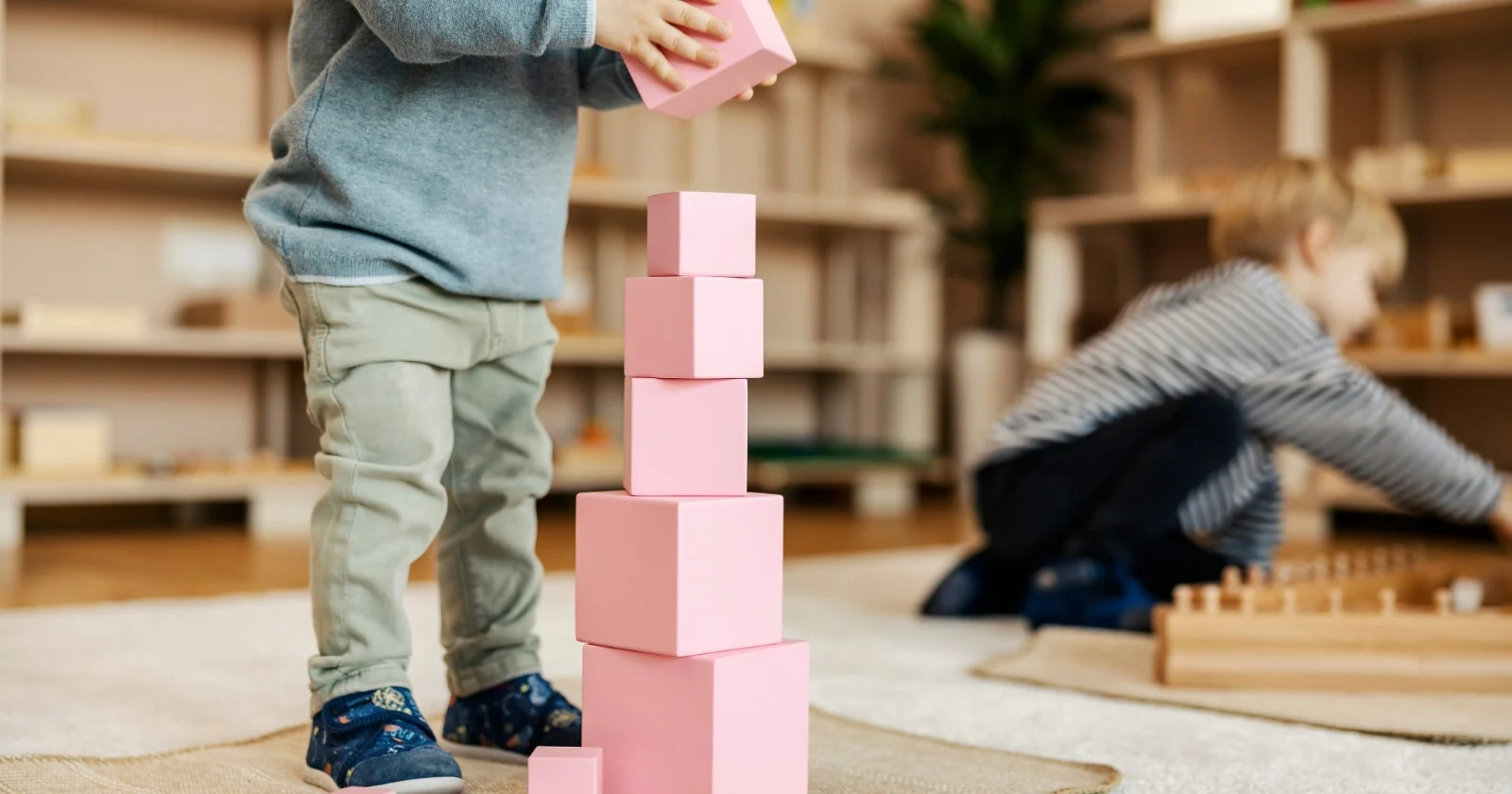
A Montessori school follows the teaching approach that Italian physician and educator Maria Montessori developed more than a century ago, according to the American Montessori Society (AMS). Children learn in mixed-age classrooms, pick much of their own work from hands-on materials, and get long blocks of time to do it. Montessori opened her first school in Italy in 1907, and AMS notes it was a public school.
Most Montessori schools in the U.S. are private. An undated AMS fact sheet estimates about 5,000 Montessori schools in the U.S., about 500 of them public. A newer tally from the National Center for Montessori in the Public Sector (NCMPS) counted 596 public Montessori schools and programs in 43 states and Washington, D.C., as of June 2026. The first public Montessori school in the country was Hilltop School in Reading, Ohio, in 1967, according to AMS.
AMS lists five core parts of a quality program: trained Montessori teachers, multi-age classrooms, specially designed learning materials, student-directed work, and uninterrupted work periods. Teachers act as guides and mentors who track each child's progress and give the support and tools that child needs next. AMS sorts its levels this way: infant and toddler (birth to 3), early childhood (ages 2.5 to 6), elementary (6 to 9 and 9 to 12, sometimes combined), and secondary (12 to 18, in two- or three-year groups).
The Association Montessori Internationale (AMI), which Maria Montessori founded in 1929, sets similar rules. Under the AMI standards published by its U.S. affiliate, a primary classroom serves children ages 2.5 or 3 to 6, holds 24 to 35 children, and runs three-hour uninterrupted work periods five mornings a week.
The name itself is not protected. AMS says "any school can call itself Montessori, regardless of its fidelity to the philosophy and practice." AMS accreditation and AMI recognition are two ways to check how closely a school follows the model.
Public Montessori schools, whether neighborhood, magnet, or charter, charge no tuition for kindergarten through 12th grade. Free preschool seats depend on state pre-K rules and the district. Private programs often charge high tuition, as the authors of the 2025 study below noted. Our explainer on what a charter school is covers how charter and district-run schools differ.
How many public schools have Montessori in the name
In the 2024-25 school year, 309 operating public schools had "Montessori" in their school name, according to allk12's analysis of National Center for Education Statistics (NCES) data. They sat in 34 states and Washington, D.C., and enrolled 98,480 students. That works out to about 3 of every 1,000 public schools (309 divided by 100,119 is 0.31%).
Charters make up the larger share. Of the 309, 175 (57%) are charter schools, which are publicly funded but run independently, and 134 (43%) are run by school districts. Enrollment is closer to even: 46,759 students in the charters and 51,721 in the district schools.
Searching by name misses a lot. AMS notes that some public programs run as a "school-within-a-school," sharing a building with classrooms that teach a different way, so the school's name may give no hint. The name search finds about half the NCMPS count (309 divided by 596 is 52%), and it misses district schools most: 134 of NCMPS's 366 (37%), compared with 175 of its 230 charters (76%). The two lists were built differently and may not match school by school, so these shares are rough. NCMPS also says its schools serve just under 200,000 children, roughly twice the enrollment of the name-matched schools.
Texas has the most name-matched schools, 31, followed by Wisconsin (26), Michigan (24), Arizona (23), and California (22). In Arizona, 20 of 23 are charters. In Ohio, all 13 are district-run, and eight of them belong to Cincinnati Public Schools.
| State | Schools | Charter | District-run | Students |
|---|---|---|---|---|
| Texas | 31 | 13 | 18 | 12,115 |
| Wisconsin | 26 | 17 | 9 | 5,969 |
| Michigan | 24 | 13 | 11 | 6,061 |
| Arizona | 23 | 20 | 3 | 3,986 |
| California | 22 | 17 | 5 | 9,320 |
| Colorado | 20 | 15 | 5 | 4,960 |
| Florida | 18 | 15 | 3 | 5,700 |
| Minnesota | 17 | 13 | 4 | 2,600 |
| North Carolina | 16 | 7 | 9 | 5,765 |
| Ohio | 13 | 0 | 13 | 6,750 |
| South Carolina | 10 | 4 | 6 | 3,303 |
| Indiana | 8 | 2 | 6 | 2,751 |
| Louisiana | 7 | 0 | 7 | 3,469 |
| New York | 7 | 0 | 7 | 3,220 |
| District of Columbia | 6 | 5 | 1 | 2,201 |
| Maryland | 6 | 3 | 3 | 2,628 |
| Illinois | 5 | 1 | 4 | 2,455 |
| Missouri | 5 | 2 | 3 | 1,466 |
| Pennsylvania | 5 | 4 | 1 | 1,645 |
| Washington | 5 | 0 | 5 | 1,406 |
| Alaska | 4 | 2 | 2 | 888 |
| Connecticut | 4 | 1 | 3 | 1,369 |
| Massachusetts | 3 | 1 | 2 | 847 |
| Nevada | 3 | 3 | 0 | 1,034 |
| New Mexico | 3 | 3 | 0 | 886 |
| Oregon | 3 | 3 | 0 | 700 |
| Utah | 3 | 3 | 0 | 1,062 |
| Delaware | 2 | 2 | 0 | 1,040 |
| Georgia | 2 | 2 | 0 | 360 |
| Idaho | 2 | 2 | 0 | 349 |
| Tennessee | 2 | 1 | 1 | 1,037 |
| Kentucky | 1 | 0 | 1 | 315 |
| Montana | 1 | 0 | 1 | 198 |
| Virginia | 1 | 0 | 1 | 528 |
| Wyoming | 1 | 1 | 0 | 97 |
| Total | 309 | 175 | 134 | 98,480 |
Source: allk12's analysis of NCES Common Core of Data, 2024-25. Operating public schools in the 50 states and D.C. with "Montessori" in the school name. Charter status uses the NCES charter flag. Sixteen states had no name matches.
Most of these schools are small. The median one enrolled about 290 students. About two-thirds (203 of 309) start at pre-kindergarten, and 19 run through 12th grade. The largest is California Montessori Project-San Juan Campuses, a K-8 charter in Carmichael with 1,545 students. East Texas Montessori Prep Academy in Longview serves only pre-K and kindergarten, yet it ranks third, with 1,039 students.
| School | Location | Type | Grades | Students |
|---|---|---|---|---|
| California Montessori Project-San Juan Campuses | Carmichael, California | Charter | K-8 | 1,545 |
| Yonkers Montessori Academy | Yonkers, New York | District | PK-12 | 1,234 |
| East Texas Montessori Prep Academy | Longview, Texas | Charter | PK-K | 1,039 |
| Hammond Westside Montessori | Hammond, Louisiana | District | PK-8 | 1,022 |
| Innovation Montessori Ocoee | Ocoee, Florida | Charter | K-12 | 919 |
| MacDowell Montessori School K3-12 | Milwaukee, Wisconsin | District | PK-12 | 823 |
| Community Montessori | Escondido, California | Charter | K-8 | 795 |
| Garden Oaks Montessori | Houston, Texas | District | PK-8 | 763 |
| Creative Montessori Academy | Southgate, Michigan | Charter | PK-8 | 759 |
| Casa Esperanza Montessori Charter School | Wake Forest, North Carolina | Charter | PK-8 | 752 |
Source: allk12's analysis of NCES Common Core of Data, 2024-25 enrollment. Type uses the NCES charter flag.
What the research found
Two studies led by University of Virginia psychologist Angeline Lillard used admissions lotteries, comparing children who won a seat with children who applied and lost, so the main difference between the groups was luck.
The first, published in 2017 in Frontiers in Psychology, followed 141 children who entered a lottery for two public Montessori magnet schools in Hartford, Connecticut: 70 who attended Montessori and 71 who went to other schools. They were tested from age 3 to about 6, and the groups started out even. Over time, the Montessori children did better on academic achievement, social understanding, and mastery orientation, which is a willingness to take on hard tasks to learn. By the end, lower-income Montessori children's academic scores were not significantly different from those of higher-income children in conventional schools. It covered just two schools in one city.
The larger follow-up appeared on October 20, 2025, in the Proceedings of the National Academy of Sciences. It tracked 588 children who entered lotteries in 2021 for 3-year-old pre-K seats at 24 public Montessori schools; 242 were offered a seat and 346 were not. The groups performed similarly at ages 3 and 4. By the end of kindergarten, children offered a seat scored significantly higher in reading, short-term memory, executive function (skills like self-control and holding a rule in mind), and social understanding. The effect sizes ranged from 0.22 to 0.30 standard deviations. Gaps in math and vocabulary were not statistically significant.
The authors also estimated that three years of public Montessori, from age 3 through kindergarten, cost districts $13,127 less per child than a traditional program. They traced most of the savings to the intentionally higher number of children per adult in Montessori's 3- and 4-year-old classrooms.
The authors list limits. Only 20.9% of the families contacted agreed to take part, the 24 schools were not chosen at random, and 32% of the Montessori group and 42% of the comparison group were missing kindergarten test scores. The federal What Works Clearinghouse rated it as meeting its standards with reservations because of that high attrition, the share of children missing from later testing. The authors wrote that they "do not know whether the study children will continue to do well in their later school years."
Sources
American Montessori Society: Fast Facts: What Is Montessori?
American Montessori Society: Fast Facts: Public Montessori Schools
AMI/USA: Standards for AMI Montessori Classrooms
Association Montessori Internationale: 1929 Where It All Began
National Center for Montessori in the Public Sector: Building public Montessori together (June 2026)
Frontiers in Psychology: Montessori Preschool Elevates and Equalizes Child Outcomes: A Longitudinal Study (Lillard et al., 2017)
PNAS: A national randomized controlled trial of the impact of public Montessori preschool at the end of kindergarten (Lillard et al., 2025)
UVA Today: UVA-led national study finds Montessori preschool boosts learning, cuts costs
What Works Clearinghouse: Review of Lillard et al. (2025)
School counts and enrollment from allk12's analysis of National Center for Education Statistics (NCES) Common Core of Data, 2024-25.