


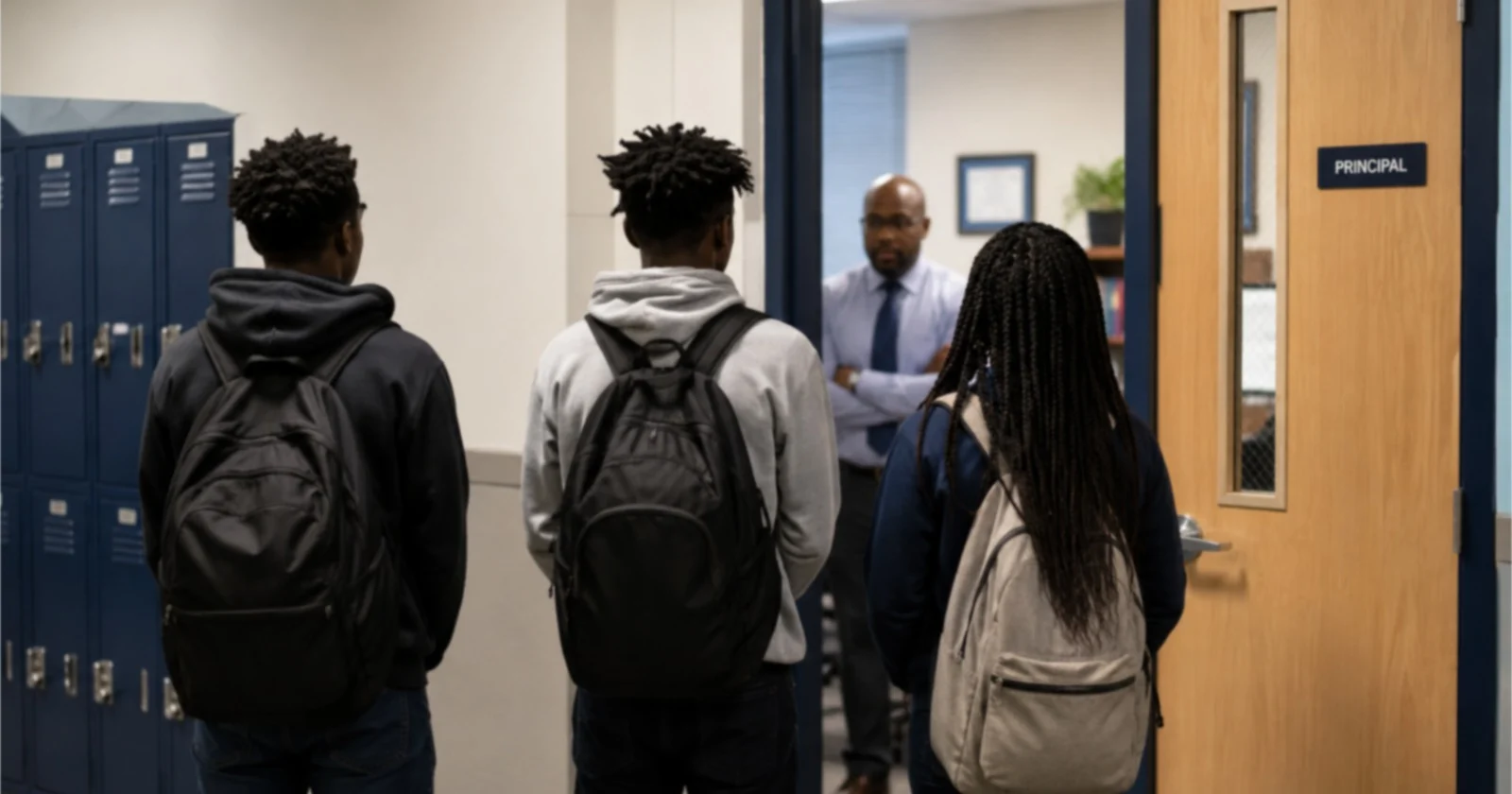
Superintendent John Mulford learned that his district was under federal investigation about two hours before the U.S. Department of Education announced it to the country.
Fayetteville Public Schools in Arkansas, which enrolls roughly 10,300 students across 17 schools, was named in a department press release alongside Milwaukee Public Schools, a district of about 65,800 students. The stated reason for the Fayetteville inquiry: teachers there "were directed to take students' racial identities into account when issuing discipline" as part of a restorative justice effort addressing "the disproportionality of discipline on students of color."
"We're a little shocked at this point and completely in the dark as to what this is even about," Mulford told NPR. He said his district has spent years tightening its discipline policy specifically to remove ambiguity, and that its approach aligns with federal civil rights law. Milwaukee's spokesperson said the notice it received did not explain the reason for the investigation either.
The investigations arrived with new guidance from the department's Office for Civil Rights that reopens one of the longest-running fights in American education: when does a school discipline policy cross into discrimination?
The question underneath the fight
Everyone agrees that punishing a student more harshly because of their race is illegal, and has been for decades. The dispute is about a harder case. What if a policy looks neutral, but the data shows it falls much more heavily on one group of students? Is that evidence of discrimination, or just a number?
In 2014, the Obama administration answered yes, it can be evidence. Its guidance pointed to federal data showing Black students made up 15% of enrollment but 35% of students that were once suspended and 44% of those suspended more than once. An American Psychological Association task force found no evidence those gaps reflected differences in student behavior, suggesting instead they might stem from gaps in teacher training in classroom management or culturally competent practice, or from racial stereotypes.
Catherine Lhamon, who led the civil rights office under Presidents Obama and Biden, told NPR that ignoring race in discipline data would have been an abdication given the country's history. "The very first desegregation agreements that [the office] was created by Congress to enforce included requirements that discriminatory discipline practices end," she said, calling discriminatory discipline "a feature of discrimination" that has persisted for decades.
Districts responded. Many shifted away from suspension toward approaches like restorative justice, which emphasizes mediation over punishment. The share of students suspended at least once fell from 5.6% to 4.7%, with a 30% drop among Hispanic students and large declines for Black students and students with disabilities, though rates for those groups remained high. Enforcement continued into the first Trump administration, which in 2018 reached an agreement with Wake County schools in North Carolina after finding Black students facing a first offense were more likely to be suspended than similar white students.
The reversal
Critics argued the 2014 policy pressured districts into leniency. Conservative commentator Max Eden, later an official in the second Trump administration, wrote in 2018 that districts "must never again be presumed guilty and unable to prove their innocence, and kids should never again be put in danger because of statistics."
What followed was a decade of reversals. The first Trump administration rescinded the guidance in 2018. Lhamon reinstated a version in 2023. President Trump signed an executive order in April 2025 titled Reinstating Common Sense School Discipline Policies. And this month's guidance, signed by current civil rights chief Kimberly Richey, goes furthest of all.
Richey told NPR that under the old approach, "classrooms are less safe, they are more disruptive, and that is all a fruit of this policy. And that's why we're ending it." She characterized the previous goal as racial balancing, making discipline numbers "equal across the board" among racial groups, and rejected the premise that unequal numbers prove bias: "that everything has to be equal and, if it's not, it's inherently discriminatory. That's false."
The new guidance does not stop at warning against quotas. It states that weighing race at all, even to identify and address disparities, is itself unlawful. In its words: "The consideration of race in student discipline is race discrimination."
The other side
Civil rights groups say that standard makes discrimination impossible to detect. Eric Duncan of EdTrust, which works on education equity, said schools "must be able to examine who is being suspended, expelled, or referred to law enforcement, why those decisions are being made, and whether students are being treated differently for similar behavior. That is not preferential treatment. It is basic accountability."
Lhamon argues the disparities will not disappear, only become invisible. She called the guidance "a scare tactic, designed to ensure that some of our kids in school will experience extraordinary harm." Richey frames it as the opposite, a correction restoring the law: "You cannot take race into account when you're disciplining students. It can't play a factor, and the racial balancing must end."
Caught between the two positions are districts trying to guess what compliance now means. Mulford said his team does review Fayetteville's discipline data, but "we never talk about, 'Hey, go softer or harder on this particular group of people.' That doesn't even come into our language at all. So we preach consistency, the standard is the standard, everybody's held to the standard." He said he welcomes the investigation. "If we're doing something wrong, we'll get it fixed." He just doubts they will find inconsistency in Fayetteville.
For families, the practical effect is that a policy area shaping who gets suspended has now changed direction four times in twelve years, and districts have to rebuild their approach each time. If you want to understand how discipline decisions actually get made in your own school, our guides on raising an issue at a school board meeting and the debate over accountability in classrooms are useful starting points.
Sources
NPR: When is suspending students discrimination? Education Department renews an old fight
U.S. Department of Education: press release on student discipline guidance and investigations
District enrollment figures from allk12's analysis of National Center for Education Statistics (NCES) data, 2024-25.