



Nearly 11 years after the head of the National Highway Traffic Safety Administration (NHTSA) said every child on every school bus should have a three-point seat belt, only nine states require passenger belts on school buses.
Those states are Arkansas, California, Florida, Iowa, Louisiana, Nevada, New Jersey, New York, and Texas, according to the National Conference of State Legislatures (NCSL) and the states' own laws. Iowa's requirement is a state education rule adopted in 2019. Arkansas and Louisiana's laws "are subject to appropriations or approval or denial by local jurisdictions," NCSL says.
Federal rules require lap or lap/shoulder belts only on small school buses, those with a gross vehicle weight rating of 10,000 pounds or less, according to NHTSA. That rating is the most a vehicle is built to weigh fully loaded.
NHTSA calls the school bus one of the safest vehicles on the road. From 2015 to 2024, 39 school-age children, 18 and younger, were killed while riding in school transportation vehicles, according to a July 2026 NHTSA report. That is about four a year (39 divided by 10 is 3.9). In crashes involving those vehicles over the same years, 77 school-age children died as pedestrians and 78 died riding in other vehicles.
Deaths inside school transportation vehicles, counting drivers and adults, rose from 13 in 2023 to 17 in 2024, the highest count in the report's 10 years.
How large buses protect riders
NHTSA calls its approach compartmentalization. "This requires that the interior of large buses protect children without them needing to buckle up," the agency's school bus safety page says. Riders are boxed in by strong seats placed close together, with seat backs that absorb energy. The National Transportation Safety Board (NTSB) says those seats deform in a crash so passengers "ride down" the impact and stop with the bus. Weight helps too. NHTSA says riders on big buses "experience much less crash force than those in passenger cars, light trucks and vans."
The weak spots are side impacts and rollovers, the NTSB says. In those crashes, unbelted children can be thrown from their seats, into crushed sections of the bus, or out of it.
In a November 8, 2015, speech to the National Association for Pupil Transportation, then-NHTSA Administrator Mark Rosekind said "every child on every school bus should have a three-point seat belt." He also said he was not announcing a rulemaking, the process that writes new federal requirements, and that more than 450 children die each year in personal vehicles on the way to and from school. NHTSA's school bus page still describes compartmentalization as the protection it chose for large buses.
The NTSB went further after a November 2016 crash in Chattanooga, Tennessee, where six bus passengers died. It found the lack of lap/shoulder belts contributed to the severity of the crash. In a May 2018 report, the board concluded that "properly worn lap/shoulder belts provide the highest level of protection for school bus passengers in all crash scenarios." It cited a NHTSA estimate that lap/shoulder belts may reduce school bus rollover deaths by 74%.
The board asked 42 states, the District of Columbia, and Puerto Rico, which had no lap/shoulder requirement, to pass laws requiring the belts on all new large school buses. It asked Florida, Louisiana, New Jersey, and New York to upgrade from lap belts. Since then, New Jersey moved to three-point belts in 2018, Iowa adopted its rule in 2019, and Texas expanded its law in 2025.
Which states require belts
| State | Belt type | Which buses | Notes |
|---|---|---|---|
| Arkansas | Lap/shoulder | New or leased buses used on or after January 1, 2018 | Applies only if funding is provided |
| California | Three-point lap/shoulder | Built on or after July 1, 2005 (more than 16 passengers); July 1, 2004 (other school buses) | Covers small and large buses |
| Florida | Safety belts or a federally approved restraint; type not specified | Bought new after December 31, 2000 | Riders must wear the belts |
| Iowa | Three-point lap/shoulder | New buses; rule effective October 2, 2019 | State education rule; no retrofits |
| Louisiana | Seat belts (lap belts, per the NTSB) | Buses used mainly to carry students, by June 30, 2004 | Contingent on funding |
| Nevada | Shoulder-harness type (lap/shoulder) | New buses bought by districts on or after July 1, 2019 | Must meet federal standards |
| New Jersey | Three-point lap/shoulder | Built on or after the 180th day after the August 25, 2018, law | Updated a 1992 law |
| New York | Seat belts; type not specified | Built on or after July 1, 1987 | Also requires added seat back padding |
| Texas | Three-point | All buses a district runs or contracts; compliance not required before September 1, 2029 | Budget and warranty exemptions |
Sources: NTSB Special Investigation Report SIR-18/02 (2018); NCSL; Texas S.B. 546 (2025); New Jersey P.L.2018, c.118; Nevada NRS 386.837; Florida Statutes 316.6145; New York Vehicle and Traffic Law 383; Iowa Administrative Code 281-44.3. Belt types are as written in each law or as described by the NTSB.
Seven of the nine rules apply only to buses bought or built after a set date, so older buses without belts can stay in service until they are replaced.
Texas now reaches older buses too. Senate Bill 546, signed June 20, 2025, requires a three-point belt for every passenger on any bus a district operates or contracts, though districts have until September 1, 2029, to comply. A school board can skip the requirement if it decides the budget will not allow it, or if belts would void a bus's warranty. The bill followed a March 2024 crash involving a Hays CISD bus that killed a pre-K student on board, Ulises Rodriguez Montoya, and a University of Texas doctoral student, Ryan Wallace, according to the Texas Senate Research Center.
Questions to ask your district
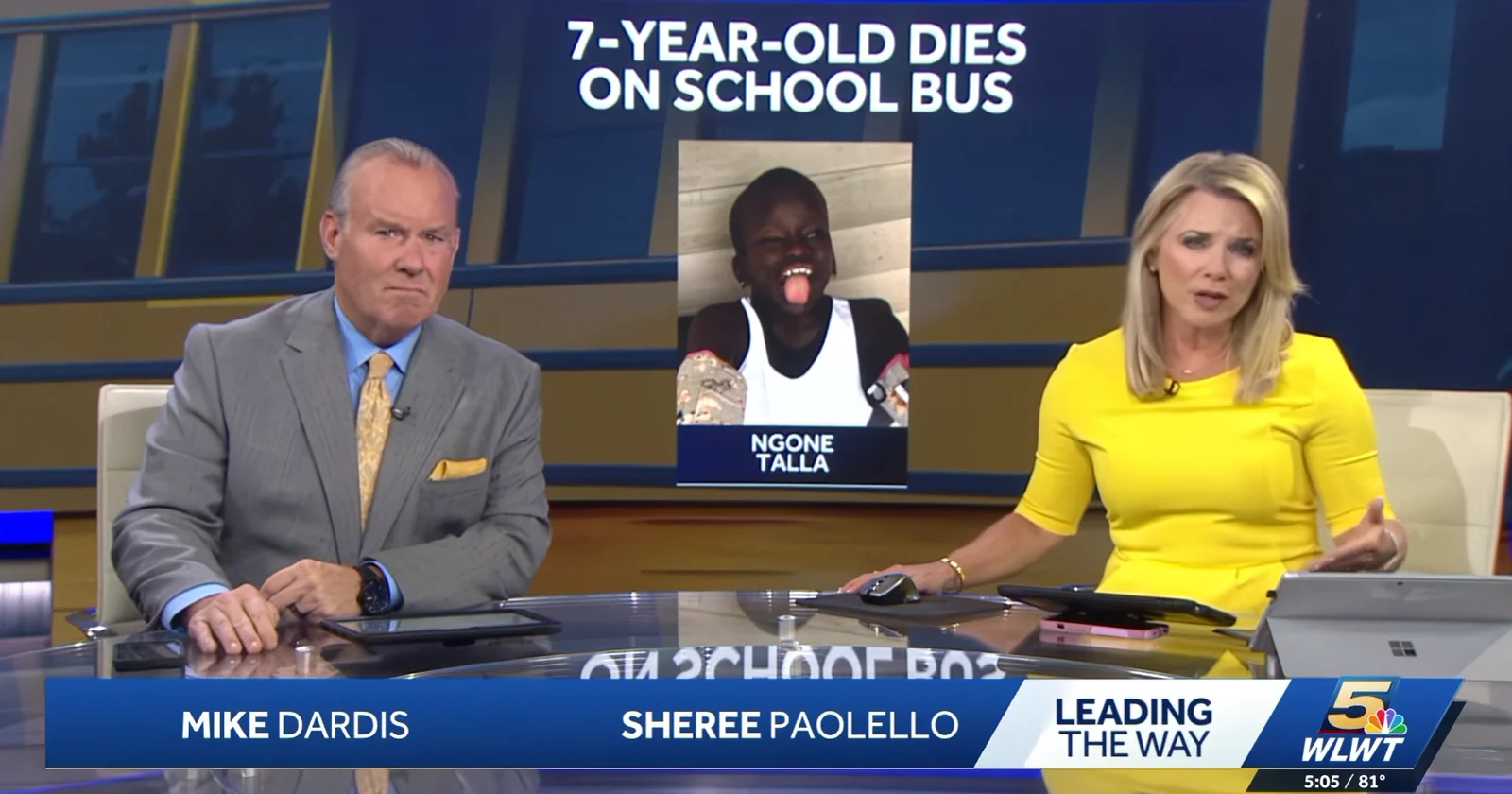
Belts are one safety question among several. After a 7-year-old died on her Cincinnati school bus in September, her father's question was who had been watching the children on board. On belts, parents can ask:
- Do the buses on my child's route have passenger belts? Ask whether they are lap or lap/shoulder belts, and how much of the fleet has them.
- Do riders have to wear them? Florida law requires it on belt-equipped buses. Ask what your district's rule is and who checks.
- Will the next bus order include belts? Federal performance standards already cover belts that districts choose to install on large buses, and the NTSB noted in 2018 that school districts in Indiana, North Carolina, Pennsylvania, Texas, and Wyoming had recently installed or required lap/shoulder belts on new large buses.
- How are drivers and students trained? The NTSB lists cost and training as challenges. Districts with belts told its investigators they saw less driver distraction and better student behavior.
- In Texas, did the board claim the budget exemption? Districts that did must report to the Texas Education Agency by the end of the 2025-26 school year and present that report at a public board meeting.
Cost is the first challenge the NTSB named, and bus budgets are already stretched this year as diesel prices squeeze districts across the country.
The walk to and from the bus carries its own risk. NHTSA says "children are more at risk when approaching or leaving a school bus," and it tells parents to have children arrive at the stop at least five minutes early and wait at least 10 feet from the curb. From 2015 to 2024, more school-age pedestrians died in school-transportation crashes between 7 and 7:59 a.m. than during any other hour, NHTSA's report found.
Sources
NHTSA: School Bus Safety
NHTSA: School-Transportation-Related Traffic Crashes, 2015-2024 Data (July 2026)
NHTSA: Remarks by Administrator Mark Rosekind to the National Association for Pupil Transportation (November 8, 2015, archived)
NTSB: Selective Issues in School Bus Transportation Safety, Crashes in Baltimore, Maryland, and Chattanooga, Tennessee (2018)
NCSL: School Bus Safety
Texas Legislature: S.B. 546, enrolled version
Texas Senate Research Center: Bill Analysis, S.B. 546
New Jersey Legislature: P.L.2018, c.118
Nevada Legislature: NRS 386.837
Florida Legislature: Florida Statutes 316.6145
New York State Senate: Vehicle and Traffic Law 383
Iowa Legislature: Iowa Administrative Code, Chapter 281-44, School Buses