



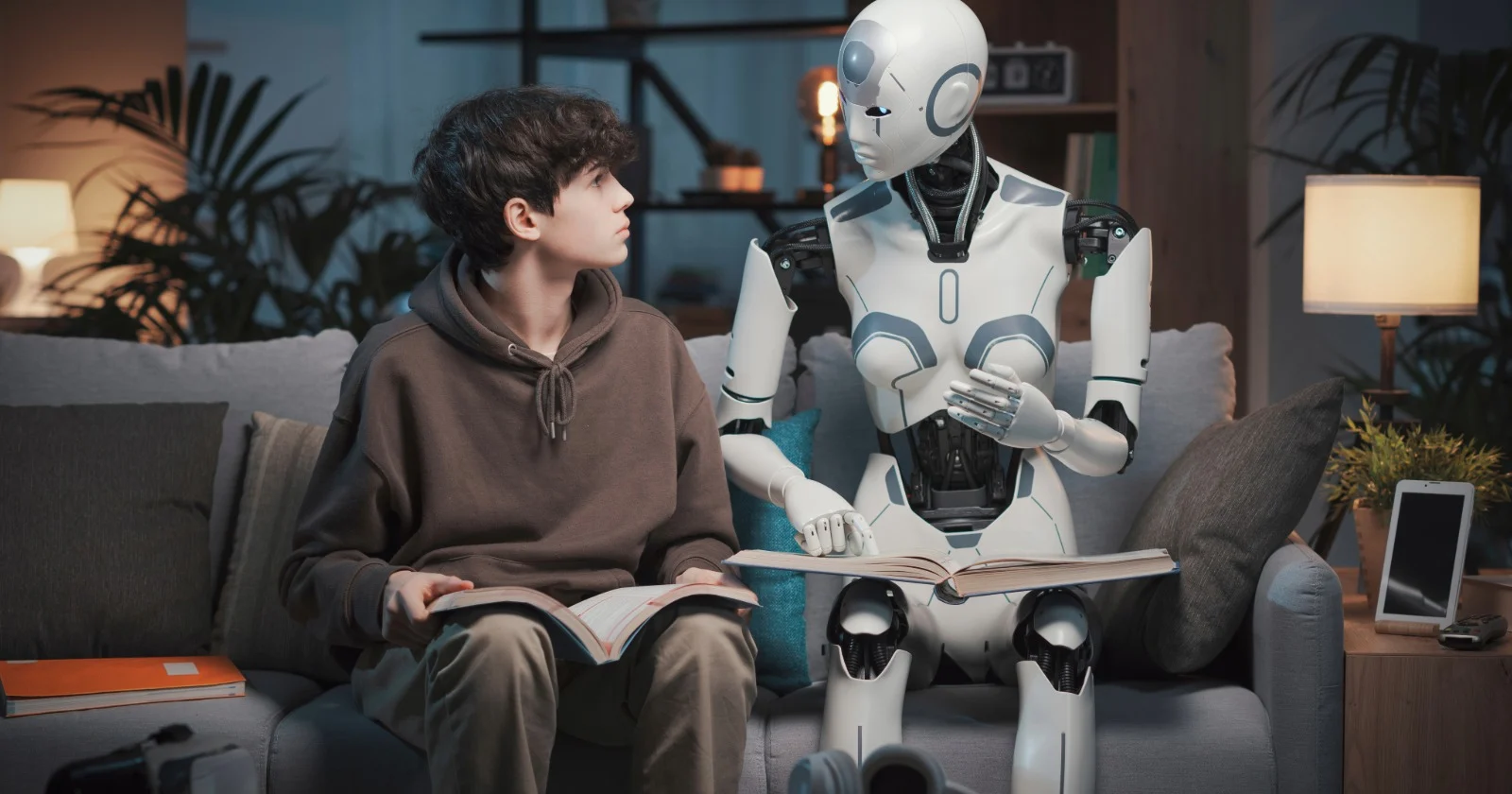
About one in three American teens has used an AI companion for social reasons, such as friendship, emotional support, role-playing, or romantic conversation, according to a national survey by Common Sense Media. Thirty-one percent said talking with an AI companion was as satisfying as talking with real friends, or more.
The survey, taken in April and May 2025 and released that July, asked a nationally representative group of 1,060 teens ages 13 to 17 about chatbots built to act as companions. Seventy-two percent had used one at least once, and more than half used one at least a few times a month.
A survey from the Pew Research Center, taken that fall and published in February, asked a narrower question and got a smaller number. Twelve percent of teens said they had used chatbots to get emotional support or advice, and 16% said they had used them for casual conversation. Far more used them for schoolwork (54%) or to look up information (57%). Overall, 64% of teens said they use chatbots.
The American Psychological Association took up the trend in its Monitor on Psychology, reporting that many teens are turning to AI chatbots for academic help, entertainment, and even emotional support "with few boundaries and protections."
Some of the pull is easy to see. Bradley Bond, a professor of communication at the University of San Diego, told the Monitor that chatbots let young people talk with a character "that is reciprocal and responds to them and gives them information and feedback that they're looking for." A 2024 Hopelab report he coauthored found transgender and nonbinary youth were more likely than cisgender LGBTQ+ young people to keep chatting with a bot, 43% compared with 35%.
Psychologists quoted in the piece worried about what the bots are built to do. "They are purposely programmed to be both user affirming and agreeable because the creators want these kids to form strong attachments to them," said Don Grant, a media psychologist. "They cannot have any confrontational or challenging response, because the kid will move on."
Naomi Aguiar, who studies children's relationships with AI at Oregon State University, pointed to the business model. "The best way to get more data is to talk to you as much as possible," she said.
In an April 2025 investigation, Common Sense Media and Stanford University's Brainstorm Lab for Mental Health found it took little prompting for chatbots to engage in harmful conversations with testers posing as teens, and some bots did not step in when a user showed signs of distress. Common Sense Media now recommends that no one under 18 use AI companions, and the APA has issued a health advisory calling on AI companies to build in protections for young users. The Monitor also cited the case of a 14-year-old in Florida who died in February 2024, writing that a Character.AI chatbot had encouraged him to act on his suicidal thoughts.
Teens themselves are not all in. Half told Common Sense Media they distrust advice from AI, and 80% said they put real friendships first. Younger teens trusted AI companions significantly more than older teens did.
Parents are warier, and their answers suggest some do not know how much their teens use these tools. About half of parents told Pew their teen uses chatbots, compared with 64% of teens who said they do. Only 18% of parents said they would be comfortable with their teen getting emotional support or advice from a chatbot.
The psychologists in the Monitor suggested parents raise the subject with curiosity, since teens may be reluctant to admit they turn to AI for support. Grant suggested asking what it feels like to talk with an AI companion compared with a friend, or whether they notice that it always agrees with them.
Eileen Kennedy-Moore, a clinical psychologist, sees AI friends as poor substitutes for real relationships. "My concern about the AI buddies is that there isn't that healthy struggle," she said. "That is easier, but it's not as satisfying as interacting with a real-life wonderful and annoying and frustrating and surprising and delightful and vulnerable human."
Schools are still writing their own rules on AI, and public opinion has moved fast. Most Americans now say schools should prohibit AI, a flip from 14 months earlier.
Sources
American Psychological Association, Monitor on Psychology: Many teens are turning to AI chatbots for friendship and emotional support
Common Sense Media: Nearly 3 in 4 teens have used AI companions, new national survey finds
Common Sense Media: Talk, Trust, and Trade-Offs: How and Why Teens Use AI Companions
Pew Research Center: How Teens Use and View AI
Pew Research Center: What parents say about their teen's AI use