
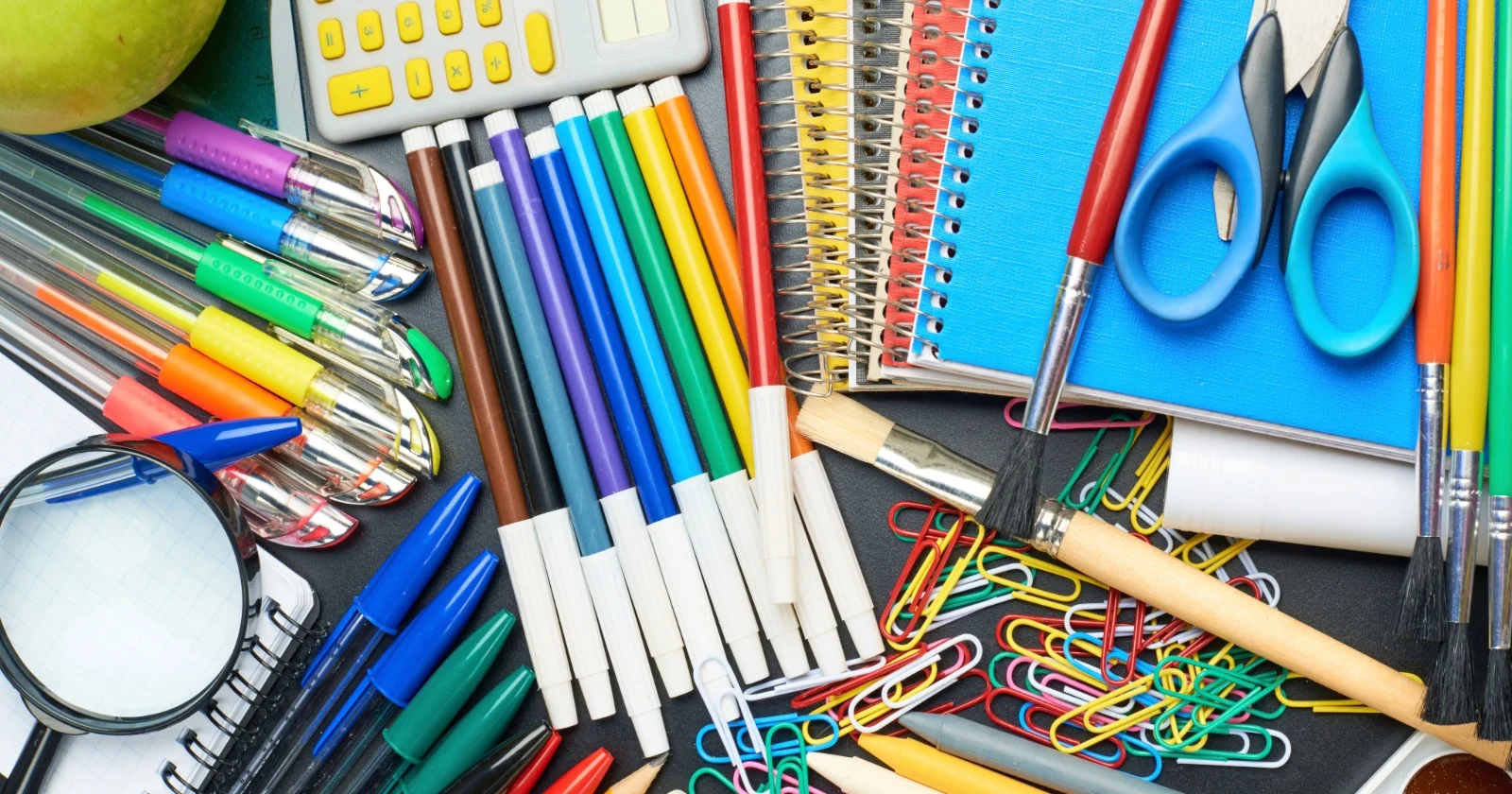
Nearly every public school teacher in the country paid for some classroom supplies out of pocket. In the most recent federal survey, 94.8% of public school teachers said they spent their own money on classroom supplies without being paid back, according to the National Center for Education Statistics (NCES). The average was $445 per teacher, a figure that counts the teachers who spent nothing as $0.
The numbers come from the 2020-21 National Teacher and Principal Survey (NTPS), which asked teachers how much of their own money they spent in the 2019-20 school year. It is the newest spending table NCES has posted. Results from its 2023-24 survey do not yet appear in the agency's published tables.
Among teachers who spent anything, the average was $470. Most kept it at $500 or less: 44.5% spent $250 or less, and 36.0% spent $251 to $500. At the high end, 7.0% spent more than $1,000. NCES also reports that 57.3% of spenders stayed at $300 or less, so 42.7% went past $300. That line matters because $300 is the most a teacher can deduct on a 2025 federal tax return.
Who spends the most
Elementary school teachers averaged $500, compared with $388 for teachers in high schools, according to the NCES table. That is a $112 gap, or about 29% more ($500 divided by $388 is 1.29). Teachers whose main assignment was early childhood or general elementary averaged $525, and 97.2% of them spent something. Math teachers averaged $362.
Spending also rose with school poverty. NCES groups schools by the share of students approved for free or reduced-price lunch, a common stand-in for family income. In schools where 75% or more of students were approved, teachers averaged $492. In schools under 35%, they averaged $403. The difference is $89, or about 22%.
That high-poverty group is large. In 2024-25, 28.5% of full-time-equivalent teachers in the 80,545 public schools that reported lunch counts, about 788,000, worked in schools where at least 75% of students were approved for free or reduced-price lunch, according to allk12's analysis of NCES Common Core of Data. Full-time equivalent is a count that adds part-time teachers as fractions. Totals by state are in allk12's breakdown of how many public school teachers each state has.
Newer teachers were less likely to pay. Among public school teachers with three years of experience or less, 85.9% spent their own money, and their average was $391. Among those with 15 or more years, 96.9% spent money, and the average was $473. Private school teachers spent less overall: 83.7% paid for supplies, and the average was $298.
State averages ranged from $691 in Alaska to $315 in South Dakota, so the Alaska figure is about 2.2 times the South Dakota figure ($691 divided by $315). California ($599), Nevada ($587), and the District of Columbia ($581) followed Alaska. Wisconsin ($322) and Vermont ($323) were just above South Dakota. In 20 of the 51 jurisdictions, the average topped the national $445.
The share who spent anything barely moved from state to state. It ran from 90.8% in Vermont to 96.9% in Iowa. The state figures are survey estimates, so states only a few dollars apart are not meaningfully different.
| State | Average spent, all teachers | Share who spent their own money | Average spent, among those who spent |
|---|---|---|---|
| U.S. public schools | $445 | 94.8% | $470 |
| Alabama | $487 | 93.2% | $523 |
| Alaska | $691 | 92.0% | $752 |
| Arizona | $428 | 93.5% | $458 |
| Arkansas | $348 | 93.0% | $375 |
| California | $599 | 94.1% | $637 |
| Colorado | $384 | 93.7% | $410 |
| Connecticut | $460 | 95.4% | $482 |
| Delaware | $495 | 96.3% | $514 |
| District of Columbia | $581 | 91.0% | $639 |
| Florida | $465 | 92.0% | $505 |
| Georgia | $459 | 96.5% | $475 |
| Hawaii | $491 | 93.8% | $523 |
| Idaho | $389 | 94.1% | $414 |
| Illinois | $384 | 94.7% | $405 |
| Indiana | $410 | 94.9% | $432 |
| Iowa | $367 | 96.9% | $378 |
| Kansas | $390 | 95.5% | $409 |
| Kentucky | $387 | 94.6% | $408 |
| Louisiana | $473 | 94.5% | $500 |
| Maine | $340 | 94.0% | $361 |
| Maryland | $485 | 94.3% | $515 |
| Massachusetts | $433 | 95.3% | $455 |
| Michigan | $482 | 95.4% | $505 |
| Minnesota | $375 | 95.0% | $395 |
| Mississippi | $378 | 91.0% | $415 |
| Missouri | $366 | 96.3% | $380 |
| Montana | $426 | 93.0% | $458 |
| Nebraska | $346 | 95.0% | $364 |
| Nevada | $587 | 95.1% | $617 |
| New Hampshire | $368 | 92.2% | $399 |
| New Jersey | $424 | 96.1% | $441 |
| New Mexico | $494 | 94.9% | $521 |
| New York | $463 | 95.0% | $487 |
| North Carolina | $431 | 96.5% | $446 |
| North Dakota | $392 | 92.6% | $423 |
| Ohio | $424 | 96.7% | $438 |
| Oklahoma | $498 | 96.8% | $515 |
| Oregon | $430 | 92.5% | $465 |
| Pennsylvania | $401 | 95.8% | $418 |
| Rhode Island | $529 | 96.5% | $547 |
| South Carolina | $379 | 93.0% | $407 |
| South Dakota | $315 | 95.3% | $331 |
| Tennessee | $398 | 94.9% | $419 |
| Texas | $485 | 95.5% | $508 |
| Utah | $369 | 91.4% | $403 |
| Vermont | $323 | 90.8% | $356 |
| Virginia | $374 | 95.8% | $390 |
| Washington | $453 | 94.4% | $480 |
| West Virginia | $396 | 92.5% | $428 |
| Wisconsin | $322 | 93.6% | $344 |
| Wyoming | $502 | 95.6% | $525 |
Source: NCES, National Teacher and Principal Survey, 2020-21, table on teachers' unreimbursed spending on classroom supplies during the 2019-20 school year. Public school teachers only. The "all teachers" average counts teachers who spent nothing as $0.
What the federal tax deduction covers
The educator expense deduction lets eligible educators subtract up to $300 of unreimbursed costs on a 2025 return, or $600 for a married couple filing jointly when both are educators, with no more than $300 each, according to IRS Topic 458. It is claimed on Schedule 1, and the IRS says educators can take it even if they use the standard deduction.
To qualify, a person must be a kindergarten through grade 12 teacher, instructor, counselor, principal, or aide for at least 900 hours a school year. Covered costs include books, supplies, computer equipment and software, other equipment, professional development courses, and supplementary materials used in the classroom. For health or physical education courses, supplies must be athletic supplies. Any reimbursement not reported in box 1 of a teacher's W-2 reduces the amount that can be deducted.
The cap was $250 a year from 2002 through 2021, the IRS said in 2022, so it was $250 when teachers reported their 2019-20 spending. It rose to $300 in 2022. For 2026, IRS Revenue Procedure 2025-32 raises it to $350 per educator.
A second break starts with 2026 returns. Public Law 119-21, signed July 4, 2025, created an itemized deduction for educator expenses that applies without the dollar limit. It also counts interscholastic sports administrators and coaches as educators, drops the athletic-only rule for health and physical education supplies, and covers items used "as part of instructional activity" instead of only "in the classroom". It only helps teachers who itemize, which pays off when itemized deductions add up to more than the 2026 standard deduction of $16,100 for single filers or $32,200 for married couples filing jointly.
A higher figure comes from AdoptAClassroom.org, a nonprofit that funds classroom purchases. Its Spring 2025 survey of 3,700 K-12 teachers put average out-of-pocket spending at $895 for the 2024-25 school year, and teachers reported a median school supply budget of $200. The group sent the questionnaire through its own educator network, so its results are not directly comparable with the NCES survey, which is weighted to represent all teachers. Parents carry part of the load through supply lists, and allk12 has reported on how back-to-school shopping is pushing more parents into debt. Teacher salaries by state are in allk12's look at the states with the best teacher pay.
Sources
NCES: Teachers' unreimbursed spending on classroom supplies, National Teacher and Principal Survey, 2020-21
NCES: 2020-21 NTPS Teacher Questionnaire
IRS: Topic no. 458, Educator expense deduction
IRS: Revenue Procedure 2025-32 (2026 inflation adjustments)
IRS: Maximum educator expense deduction rises to $300 in 2022 (IR-2022-148)
GovInfo: Public Law 119-21, Section 70110
AdoptAClassroom.org: 2025 Teacher Spending Survey
Teacher counts from allk12's analysis of National Center for Education Statistics (NCES) Common Core of Data, 2024-25.