




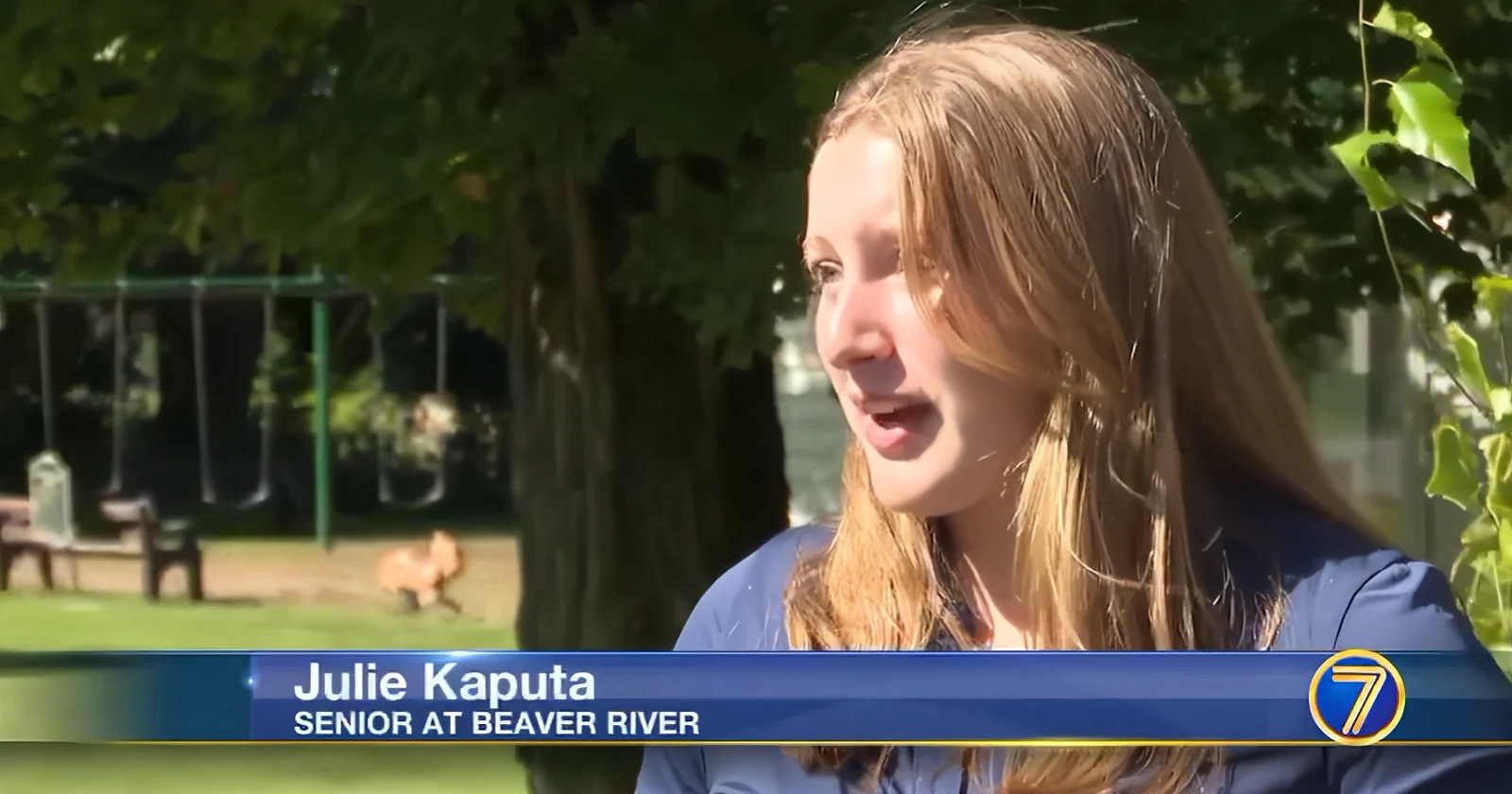
On the first day of school, Julie Kaputa walked into her first-period class at Beaver River Central School in Castorland, New York, carrying a cup of coffee she was not supposed to have.
"I walked in, I had my coffee with me. I got to my first period class, and my teacher said, 'I'm either going to need you to dump that out or consume it on the spot, or go down to the office,'" the senior told WWNY. She went to the office, and she got an in-school suspension.
The rule she broke was new. This school year, the district added a line to its code of conduct saying students "arriving with food or drinks will be asked to consume it before entering the school," according to a Facebook post by her mother, MaryAnne Kaputa. The previous year's policy banned food deliveries without staff approval and put no limit on students bringing their own food and drinks to eat during the school day.
Julie is an honors student and the student body president, and she knew about the rule before she walked in. Her mother wrote that Julie "politely refused the request as a form of civil disobedience to draw attention to the school's multiple Open Meeting Law violations," and that she picked coffee "because as the Student Body President she had the support for all of her classmates on this issue." Julie said the suspension will not go on her permanent record, and her mother says the school eventually let her back into class with the coffee.
What the law says, and what the district conceded
The Kaputas' argument rests on a specific sentence in state law. New York Education Law 2801 says a district's code of conduct "shall be adopted by the school board or trustees only after at least one public hearing that provides for the participation of school personnel, parents, students and any other interested parties." Districts must review the code every year, and an updated code needs the same hearing before it can be reapproved.
"It says there's supposed to be a public hearing. When was that? We never knew about it. Did they announce it?" MaryAnne Kaputa recalled her daughter asking. "And I said, 'I don't know, look.' And we couldn't find one."
Superintendent Todd Green responded in a Sept. 10 statement that the district's August board meeting was, in effect, the hearing, while admitting the public had no way of knowing that. "While our annual review process mirrors a public hearing in practice, we acknowledge the advance notice did not explicitly contain the phrase 'Public Hearing,' and that the public may not have realized they were entitled to speak on the Code of Conduct before action was taken by the Board," he wrote. "Because we hold ourselves to the highest standard of compliance, we are correcting this administrative detail."
The statute's wording is about participation by students, parents, and staff, which is the part the Kaputas say never happened. The district has scheduled a hearing labeled as one for Monday, Sept. 14.
Green was gracious about the challenge. "It's good to see students standing up for what they believe in," he told WWNY. "We're a school district. We're trying to do the best we can throughout this process. We know there's open meeting laws. We try to follow that. If things get pointed out that we need to do and change or fix, we'll do that." He said the rule was put in place to improve the learning environment.
The minutes question
MaryAnne Kaputa has made a second claim, in a separate post: that minutes from the board's July and August meetings did not appear on the district website until she asked about them. The district has not publicly addressed that one.
Beaver River is a small rural district in Lewis County. Beaver River Senior High School enrolls about 254 students in grades 9 through 12, according to federal data, with a student-teacher ratio near 12 to 1. The district's three schools serve about 860 students in all.
Petitions against the rule are circulating among students, staff, and parents, MaryAnne Kaputa wrote, calling it overly restrictive and unenforceable. For families elsewhere who want to try the same thing without taking a suspension first, our guide to getting something done at a school board meeting covers how public comment actually works.
Sources
WWNY: Beaver River student suspended over coffee challenges rule
People: High school student suspended on the first day of class for bringing coffee
New York Education Law Section 2801: Codes of conduct
New York Public Officers Law Section 106: Minutes
Enrollment and staffing figures from allk12's analysis of National Center for Education Statistics (NCES) Common Core of Data.