


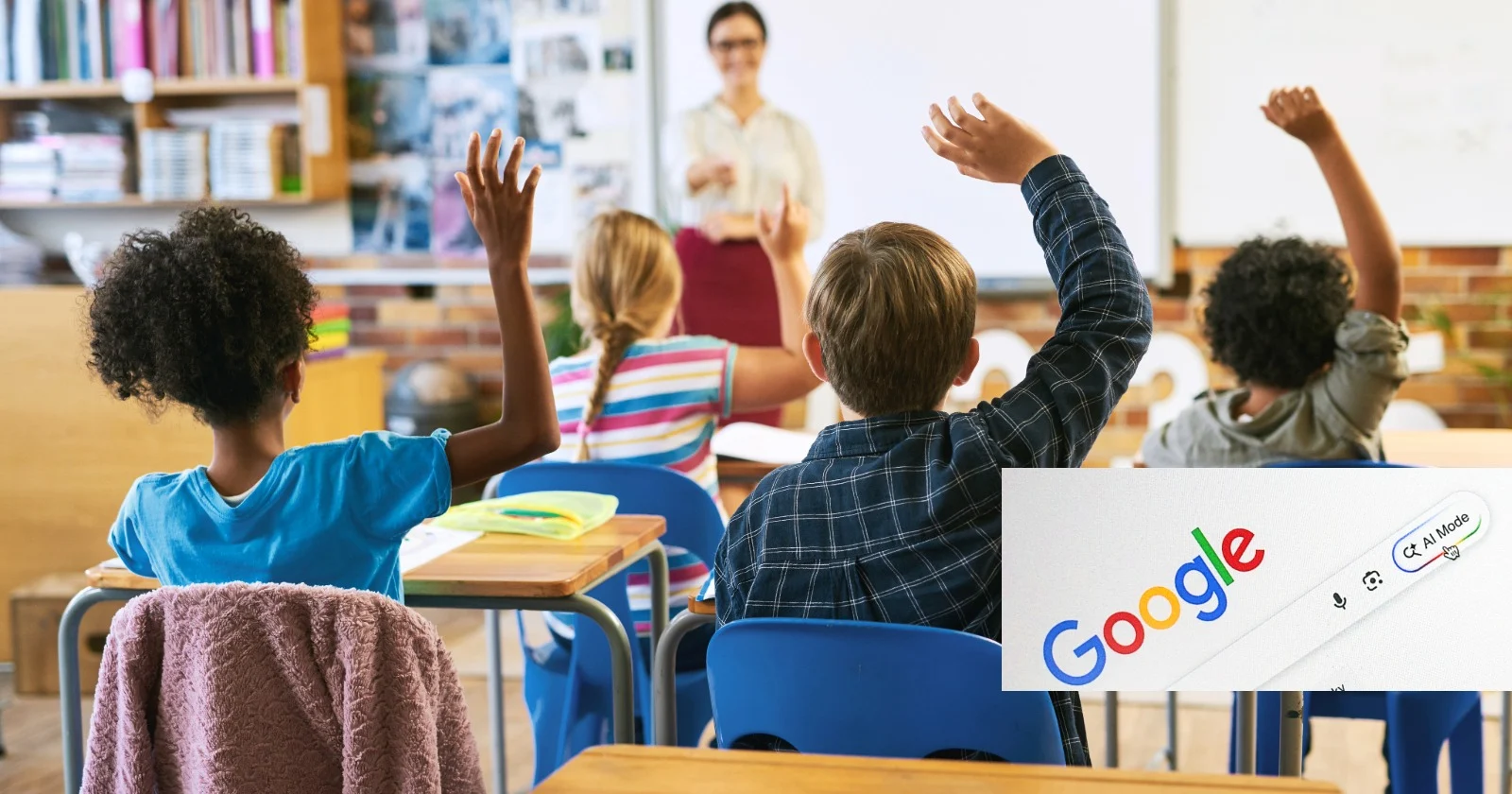
Millennials grew up being warned in class not to fully trust Wikipedia, to be wary of random forum posts, and to hunt down primary sources. The place a teacher told you to start was Google. Now, as the youngest students enter AI-powered classrooms, a child-safety group is arguing that the old advice has quietly flipped, and that a plain Google search has itself become one of the risks.
A new report from Common Sense Media concludes that Google's modernized, AI-powered Search poses an unacceptable risk to young users. The report goes further than a caution. Its authors say students should stop using it entirely until schools are able to turn the AI off.
Why a Simple Search Is Now the Problem
It is easy to see the danger in handing a young child a chatbot like ChatGPT. It is much less obvious that an ordinary Google search does something similar. Google launched AI Mode for Search last year and, unlike the more gradual AI Overviews rollout, made it available to everyone immediately, including education accounts.
That is the part experts find alarming. AI Mode is powered by Gemini, the same family of models that Google age-gates in its other products, including its own school technology suite. In other words, the AI a district deliberately keeps away from younger students in one place is switched on by default in the search box they use every day.
Google is not a bystander in schools. It helped drive the one-device-per-student movement that put Chromebooks in classrooms nationwide, and Google Workspace for Education now runs administrative systems and daily classroom tools from kindergarten through graduate school. Robbie Torney, senior director of AI programs at Common Sense Media, put the reach simply. "Google is an outsized player in both the search space and the education space." By baking generative AI into those products, often so seamlessly that users do not know they are using it, sources said Google has spent down years of accumulated trust.
Misinformation, and Homework Done for You
Researchers have found that Google's AI Overviews still repeat misinformation, an early problem the company has not fully solved, and the tidy, confident design lends an air of authority that can fool adults, let alone ten-year-olds. Common Sense Media also found the tools would readily complete homework assignments for minors. Put those together, and students may be cheating without realizing it, or at least making their own learning harder.
Amanda Bickerstaff, deputy director of the nonprofit AI for Education, which helps schools build AI-literacy programs, was blunt about it. "They are infusing AI in developmentally inappropriate ways through Search," she said. She called AI Mode a backdoor that lets students reach unsafe generative AI experiences, and said it undercuts the very literacy skills teachers are trying to build. "There is no reason why a 10-year-old, 13-year-old, or even 15-year-old should see an AI Overview or have AI Mode," she said. "You don't go to a search engine to get a chatbot answer, you go to search for real things."
The Catch That Puts Schools in a Corner
Google does not let anyone disable only the AI features while keeping Search working. Parents can turn off Search entirely or block Google.com for accounts they manage, and administrators could theoretically do the same across their Workspace for Education accounts, effectively bricking Google Search for everyone. There is no middle setting.
That leaves educators, in Bickerstaff's words, between a rock and a hard place. "What are you going to say? That kids can't search the web?"
It also means district AI rules can be broken automatically. Los Angeles Unified School District recently adopted a policy banning students under 13 from using generative AI at school, but through a Chromebook and a normal Google search, those same students can still land in AI Mode. Anya Meksin, deputy director of the coalition Schools Beyond Screens, which helped shape the Los Angeles policy, said the speed of the technology makes this almost unavoidable. "School districts are instantly in violation of any policies put in place because of the speed of the technology and the way AI is embedded," she said.
What the Critics Want, and What Google Says
Some advocates are ready to draw a hard line. "If Google is not even willing to disable AI features for students, schools should stop using Google products altogether," said David Monahan, campaign director for the child-safety nonprofit Fairplay for Kids. Both Fairplay and Schools Beyond Screens are pushing for multi-year moratoriums on generative AI in schools.
Meksin framed it as a matter of leverage. Districts are the largest buyers of these products, she argued, and could demand stronger controls or walk away. She also raised the specter of liability, pointing out that Alphabet, Google's parent company, recently faced its first wrongful-death lawsuit after a user died by suicide following conversations with Gemini, and that YouTube, also owned by Alphabet, has been found liable for design harms to minors. "We have to treat this as an emergency," she said.
Google pushed back. In a statement to Mashable, the company said Common Sense Media's stress testing was narrow and ambiguous and not an effective way to measure product safety. It noted the group tested consumer accounts rather than Workspace for Education accounts, though it also said the AI Search experience is the same for all users, which is precisely what worries the critics.
For a parent, the takeaway is not that Google is uniquely villainous or that every AI answer is dangerous. It is narrower and more useful than that. If your child uses a school-issued Chromebook, they are almost certainly meeting generative AI through the search bar, whatever your district's AI policy says on paper. That is worth knowing before the next homework assignment, and worth asking your school how, or whether, it plans to handle.
Sources
Mashable: Google's AI Search is a minefield for schools
Common Sense Media