



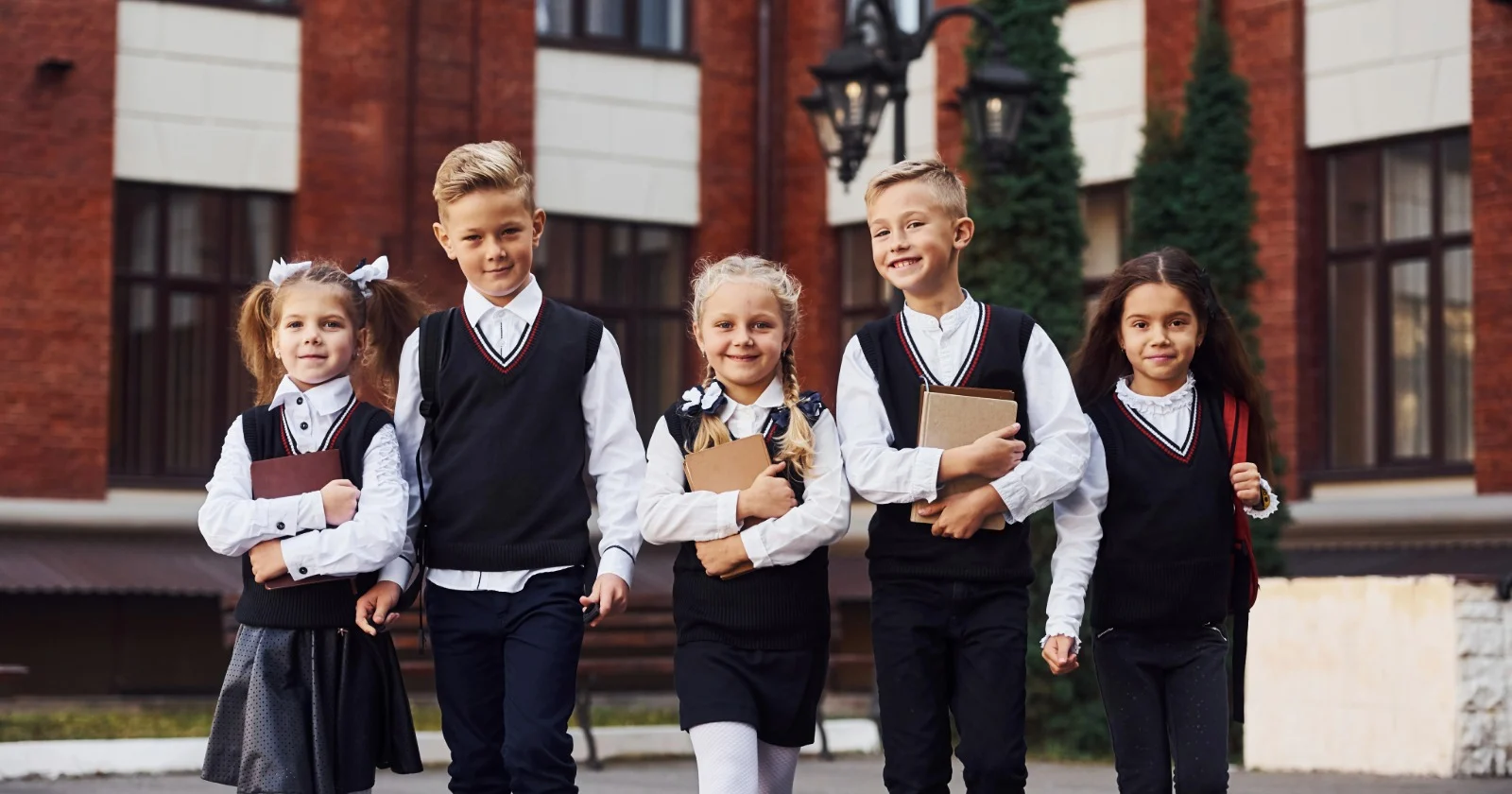
Few school policies get argued with as much certainty and as little evidence as uniforms. Supporters describe that having school uniforms transformed hallways and rising test scores. Opponents describe stifled expression and individuality.
What studies actually find
On academic achievement, the evidence is close to a flat line. A widely cited 1998 analysis found no achievement benefit and in fact a slightly negative association. A later economic analysis, examining schools before and after adopting uniforms, found no discernible effect on achievement, disciplinary infractions, or grade retention. If uniforms raised test scores meaningfully, decades of adoption should have made that easier to detect than it has been.
On behavior and attendance, results are mixed. The 1998 study found no direct effect on behavior problems, substance use, or attendance. Later work found modest attendance improvements at the secondary level, with somewhat larger effects for girls and for economically disadvantaged students at high-poverty schools. The summary is that some studies find small positive attendance effects, others find none, and nobody has found clear large ones.
That same analysis found that uniform adoption produced large increases in teacher retention in elementary schools. Why is not fully established, though reduced time spent policing dress code disputes is one possibility. In a profession with serious turnover problems, that may be the most consequential thing uniforms do.
Much of the studies are observational, comparing schools that chose uniforms with schools that did not, and schools that adopt uniforms often change other things at the same time.
The arguments that do not depend on test scores
Because the achievement case is weak, the better arguments are more practical.
The strongest is about visible economic difference. In a school without uniforms, clothing broadcasts family income every day, as some students will be wearing the latest luxury clothes and the latest trending shoes. The pressure that creates on students, and on parents' budgets, is real. We have written about this on budgets during back-to-school shopping, where clothes and shoes cost families more than school supplies do. Uniforms get rid of a lot of that, though not all of it, since shoes, coats, and everything outside school hours still give signals.
A uniform can be cheaper over a year than a wardrobe, but it is a concentrated upfront expense, and families need enough sets to get through a week of laundry. Policies that work usually come with an assistance fund and a secondhand exchange. Policies that fail often skip both.
Against that, opponents point to self-expression, to enforcement falling unevenly, and to the fact that dress code disputes tend to land hardest on girls and on students whose hair or clothing reflects their culture
How to think about it for your own school
If your school is debating uniforms, the useful question is not whether uniforms work in general. It is what problem your school is trying to solve.
If the goal is higher test scores, the evidence says it's not really gonna make a difference. If the goal is reducing daily conflict over clothing, easing economic visibility, or simplifying mornings, uniforms may help, and those goals are legitimate without needing an academic justification. Ask how the policy will be enforced and by whom, since inconsistent enforcement is what turns a dress code into a discipline problem, and ask what support exists for families who cannot easily absorb the cost.
And expect a modest result. The pattern across this research is that uniforms are neither the transformation supporters promise nor the harm opponents fear. For how these debates tend to play out in front of a board, see our guide to getting something done at a school board meeting.
Sources
Brunsma and Rockquemore, Journal of Educational Research (1998), Effects of Student Uniforms on Attendance, Behavior Problems, Substance Use, and Academic Achievement.
Gentile and Imberman, Journal of Urban Economics: Dressed for success? The effect of school uniforms on student achievement and behavior