



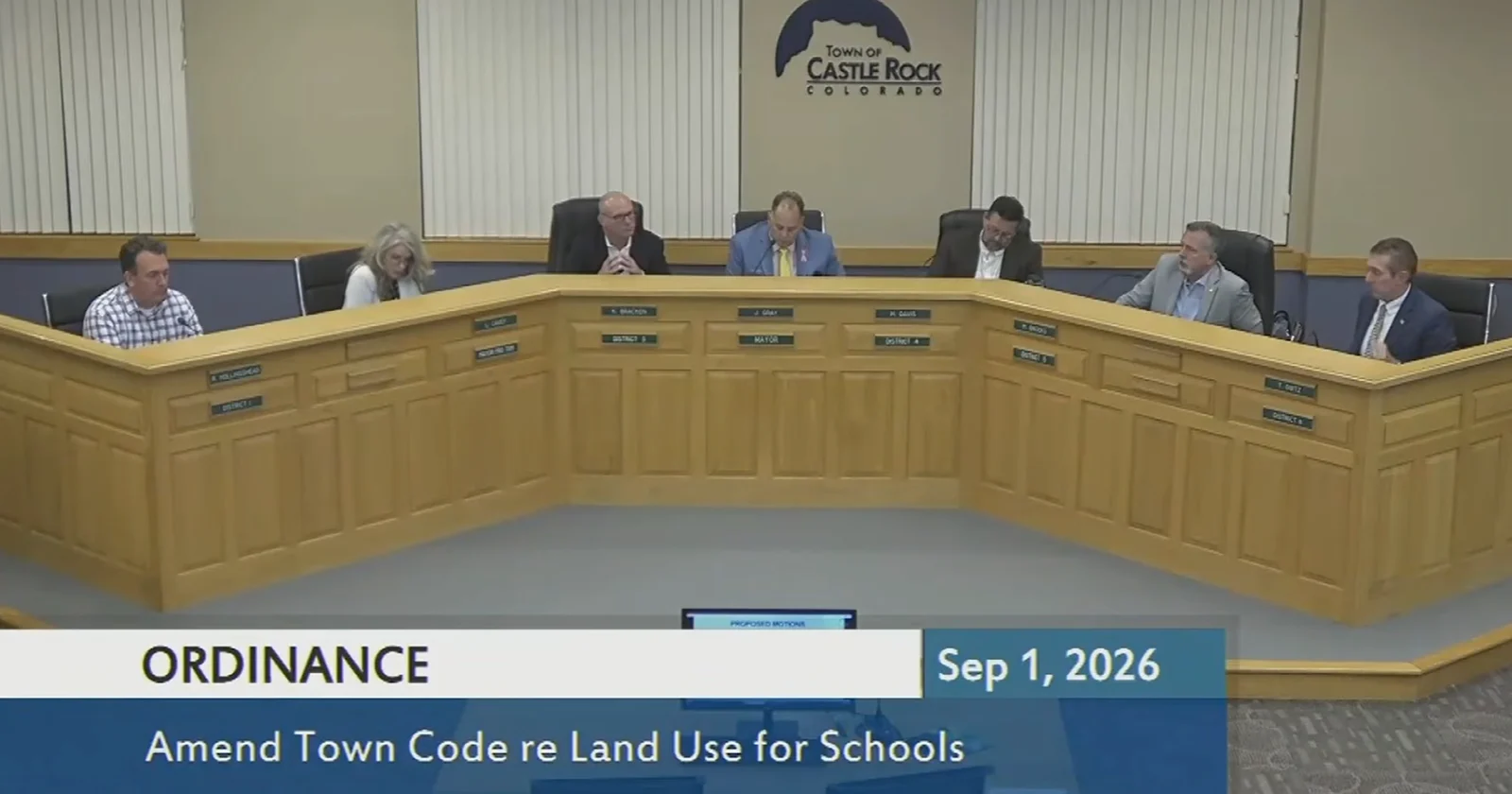
The town council in Castle Rock, Colorado voted 4-3 on Tuesday to change who controls the land developers set aside for schools, over the objections of the Douglas County School District, which says the new rules make it "difficult, if not impossible" to build new schools in one of its largest and fastest-growing towns.
The change, Ordinance No. 2026-027, amends a section of the town code that governs land and cash fees dedicated during the subdivision process. For years the arrangement was simple: a developer building a new neighborhood dedicated a parcel, or paid cash in lieu of one, and the town held it until the district was ready to build. Castle Rock now holds 13 such sites, some dating to 1999.
What the ordinance requires
Under the new language, the town "shall retain title to all land conveyed for school purposes" until the district does three things: notifies the town in writing that it intends to build, obtains approval of a site development plan, and provides "proof satisfactory to the Town" that the school board has appropriated enough money to complete the building.
Once land is conveyed, the deed must include a right of reversion. If the district does not finish the school within three years, the land goes back to the town. And if the district has not met the conditions within ten years of a site being dedicated, the council must hold a public hearing on whether to extinguish the district's rights and keep the land for "park, recreation, and/or open space uses." The ordinance requires mailed notice to the district and to every property owner within 500 feet.
Cash is handled the same way. Developer fees set aside for schools, known as cash-in-lieu, will not be passed to the district. The town "may" use them to buy land for the district, but only after the district identifies a parcel that is immediately available and proves it has the construction money.
The ordinance's stated reasoning is that "changing demographic trends, school enrollment patterns, and long-range capital planning" may leave sites undeveloped for extended periods, "creating uncertainty for nearby property owners, residents, and neighborhoods."
The 13 sites, and which ones the town has other plans for
A town memo dated July 31 lists every dedicated site. Seven are marked for consideration as parks or open space. The oldest is a 62.8-acre parcel in Castlewood Ranch, held by the town since 1999 and originally identified for a high school; the memo notes the site is "challenged with cap rock" that raises construction costs. A 10-acre site in Red Hawk was planned for an elementary school and was included in a past bond measure that voters rejected. Castle Oaks, at 3.8 acres, is described as too small for a traditional elementary school. Crystal Valley North, Sapphire Pointe, Plum Creek South, and Bella Mesa South round out the list.
Six sites remain planned for schools: Cobblestone Ranch, Crystal Valley South, Montaine, Pine Canyon, and two parcels in Dawson Trails that the developer has not yet conveyed to the town. All are slated for elementary schools. The memo also notes two Douglas County-owned sites just outside town limits in the Macanta area, one for a middle school and one for an elementary.
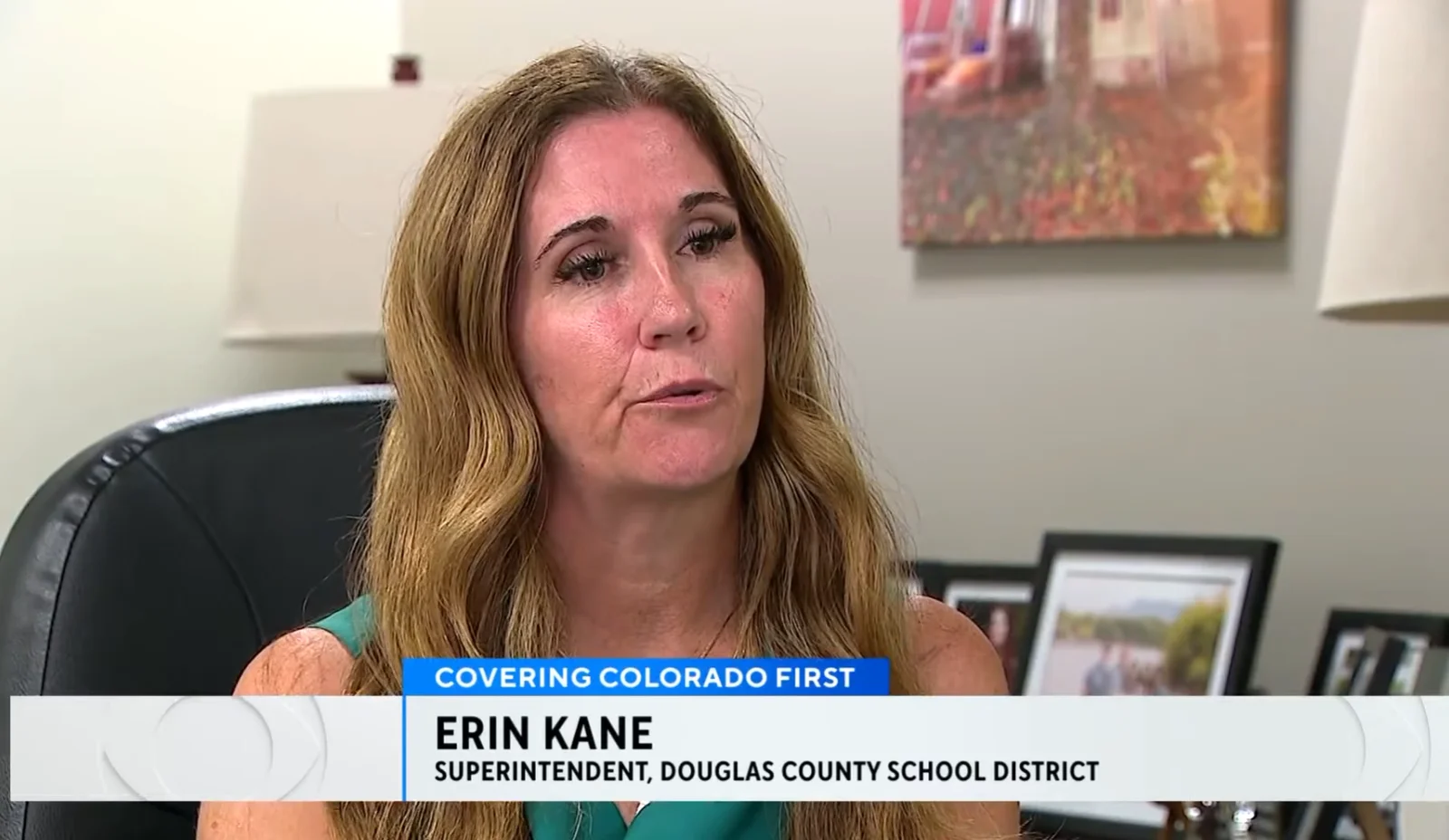
Superintendent Erin Kane told CBS Colorado that Crystal Valley and the incoming Dawson Trails neighborhoods are the ones most in need of schools.
The district's objection
Kane's central complaint is sequencing. "We have to prove that we funded a school before they will give us a site. However, the funding for a school comes from a voter-approved bond election, and our voters won't be interested in voting on a bond for a new school without having a site," she said. She also flagged the three-year build window and the town's new discretion over developer cash. "I'm not suggesting that's their intent, but under the ordinance, they can direct the land and the cash in lieu to other purposes."
The measure passed after numerous residents and district representatives spoke against it. Councilmembers Bracken and Hollingshead argued for delaying the vote and involving the district in the discussion, and joined Mayor Jason Gray in voting no. The ordinance had its first reading on August 18.
What Castle Rock schools look like now
Castle Rock is home to 22 public schools enrolling roughly 13,800 students, according to allk12's analysis of federal enrollment data. Sixteen are elementary schools. The two largest buildings are Castle View High School, with about 1,940 students, and Douglas County High School, with about 1,660. The district as a whole, Douglas County School District Re-1, runs 89 schools with about 61,500 students, which makes it one of the largest in Colorado.
The ordinance's premise, that enrollment patterns may not justify new buildings, is not unique to Castle Rock. Districts across the country are closing schools as enrollment falls, a trend we tracked in our look at school closures hitting a four-year high. Douglas County is the unusual case where growth and closure pressure coexist: new subdivisions keep arriving on the town's southern edge while older neighborhoods age out of school-age children. Colorado as a whole has seen public enrollment slip, as our state-by-state enrollment tracker shows.
The money question on the same ballot
The vote came a week after the district's board referred a $54 million mill levy override to voters. It would cost the owner of a $700,000 home about $236 a year and fund school security, student programs, and teacher pay, which Kane said remains the lowest in the Denver metro area even after a 2023 override passed.
"Thanks to that 2023 mill levy override, our turnover went from about 26% four years ago to about 13% now," Kane said. "We are still 7% below the market, but we made so much progress thanks to our voter support." Voters also approved a bond in 2024, which is paying for two elementary schools set to open next year in Sterling Ranch and RidgeGate, both outside Castle Rock.
Asked why taxpayers should say yes again, Kane pointed to property values and to the district's falling tax rate, which she attributed to fixed-dollar bonds and overrides being spread across a growing base of homeowners. On the ordinance, she said she is confident the district and the town can find a path forward, "but the language in the ordinance makes it very, very challenging."
Sources
CBS Colorado: Colorado town passes controversial school land ordinance
Town of Castle Rock, Ordinance No. 2026-027, amending Section 16.08.120 of the Municipal Code (council packet, Attachment A)
Town of Castle Rock, Future School Sites information memo, printed July 31, 2026 (council packet, Attachment B)
Enrollment figures from allk12's analysis of National Center for Education Statistics (NCES) Common Core of Data.