




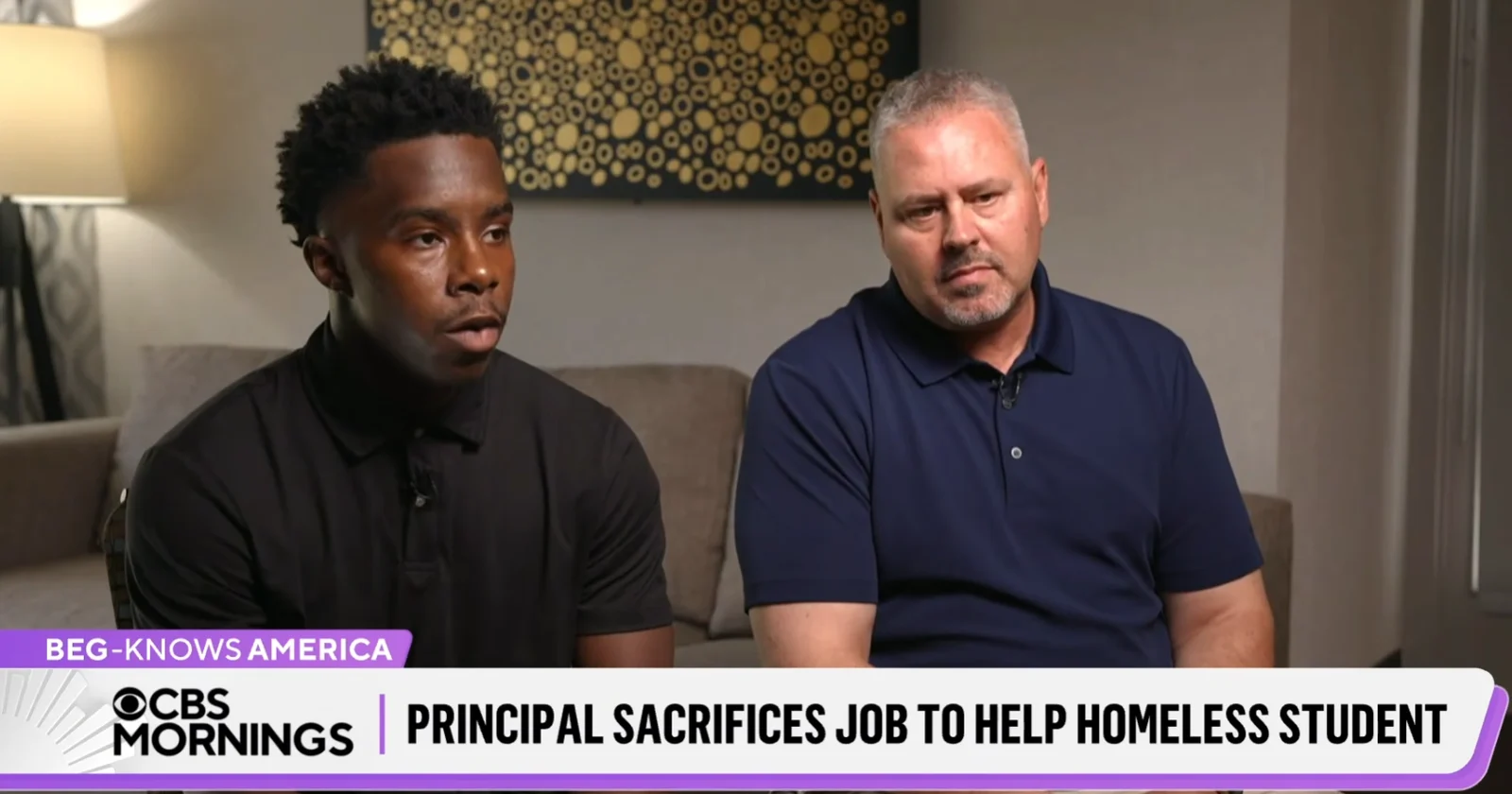
Rob Burnside spent 31 years in education, the last of them as principal of Lakota East High School, a 2,660-student school in a Cincinnati suburb. He used to wear deliberately ridiculous pants on Fridays, on the theory that a kid who laughs at your pants might talk to you.
One of the kids who talked to him was Landerius Hayes, known as DeDe. "First time I met him is when I seen him in the hallway and I was like, 'What's up, Mr. Burnside?'" Hayes told CBS Mornings. "He just dropped everything, smiled at me, and he was like, 'What's up, DeDe?'"
What Burnside did not know was that Hayes was homeless. His mother's housing was not safe, his father was struggling, and there were nights he slept in a car with the heat running because the mobile home was too cold.
That became the school's problem in Hayes' junior year, when a letter arrived showing his mother had a new address outside the district. By the district's reading, he had to withdraw. Burnside asked whether there was another way. The answer, he said, was no: "He can't be here. He doesn't have a parent who has an address. The parent resides elsewhere. He needs to go where the parent is."
Burnside went home and told his wife, Angel. "The first words out of her mouth were, 'Well, he can come stay with us, if he needs to,'" he said. The couple had already adopted two children. With the blessing of Hayes' mother, they made the offer, and within minutes of talking it over, Burnside's phone buzzed with a message from Hayes. "I think we just got our answer," he told his wife.
Hayes now had a home. He had also been withdrawn from school, and Burnside let him keep attending anyway. That ended his career. He was told the district did not believe he could return to the building as an effective leader, and was given the choice of stepping down or being terminated. He stepped down, he said, because it was better for his family.
Hayes offered to move in with his mother so Burnside could keep his job. "No. You're gonna stay with me," he recalled Burnside saying. "DeDe, you're part of this family," Burnside remembered telling him. "We're not gonna turn our back on you."
Once the Burnsides became his legal guardians, Hayes could enroll in school again. He graduated in May from a different high school, with the couple he calls Pops and Ma in the stands, and is training to become an aviation mechanic. "At first, I was in a cold car, barely eating, barely in a school, just trying to be a good person," he said. "And now, it's just, I'm eating now. I'm in the house, being a kid."
Burnside still cannot get a principal job in the area. He says he has no regrets. "Because what value can we put on the life of a young person?"
Why a law was written for this exact situation
A federal law, the McKinney-Vento Homeless Assistance Act, addresses precisely the scenario Hayes was in. Under it, a student experiencing homelessness has the right to remain in their school of origin, meaning the school they attended when last housed or where they were last enrolled, even after moving outside the district, when staying is in the student's best interest. That right lasts as long as the student is homeless and through the end of the school year in which they find permanent housing. Homeless students also have the right to enroll immediately without the documents schools normally demand, including proof of residency.
The definition of homeless is broader than most families realize. It is not limited to living on the street. It covers a student without a fixed, regular, and adequate place to sleep at night, which includes staying in a car, a motel, a shelter, or doubled up with another family because of hardship. Sleeping in a car to stay warm is squarely inside it.
The law also requires every district to designate a homeless student liaison, whose job is to identify these students, connect them to services, and resolve disputes like this one. And while such a dispute is pending, the district is supposed to let the student stay enrolled rather than push them out first and sort it out later.
If your family is in an unstable housing situation, ask your district for its McKinney-Vento liaison by name, use that word, and ask what your child's rights are before signing a withdrawal form. It is also worth knowing what support exists once a student is enrolled, from free school meals to the services that come with a 504 plan or IEP, and how chronic instability shows up in the classroom, which we cover in teaching students who are chronically absent.
Sources
CBS News: An Ohio principal allowed a homeless student to stay in school, and it cost him his job
SchoolHouse Connection: McKinney-Vento Act quick reference
School enrollment figures from allk12's analysis of National Center for Education Statistics (NCES) data, 2024-25.