



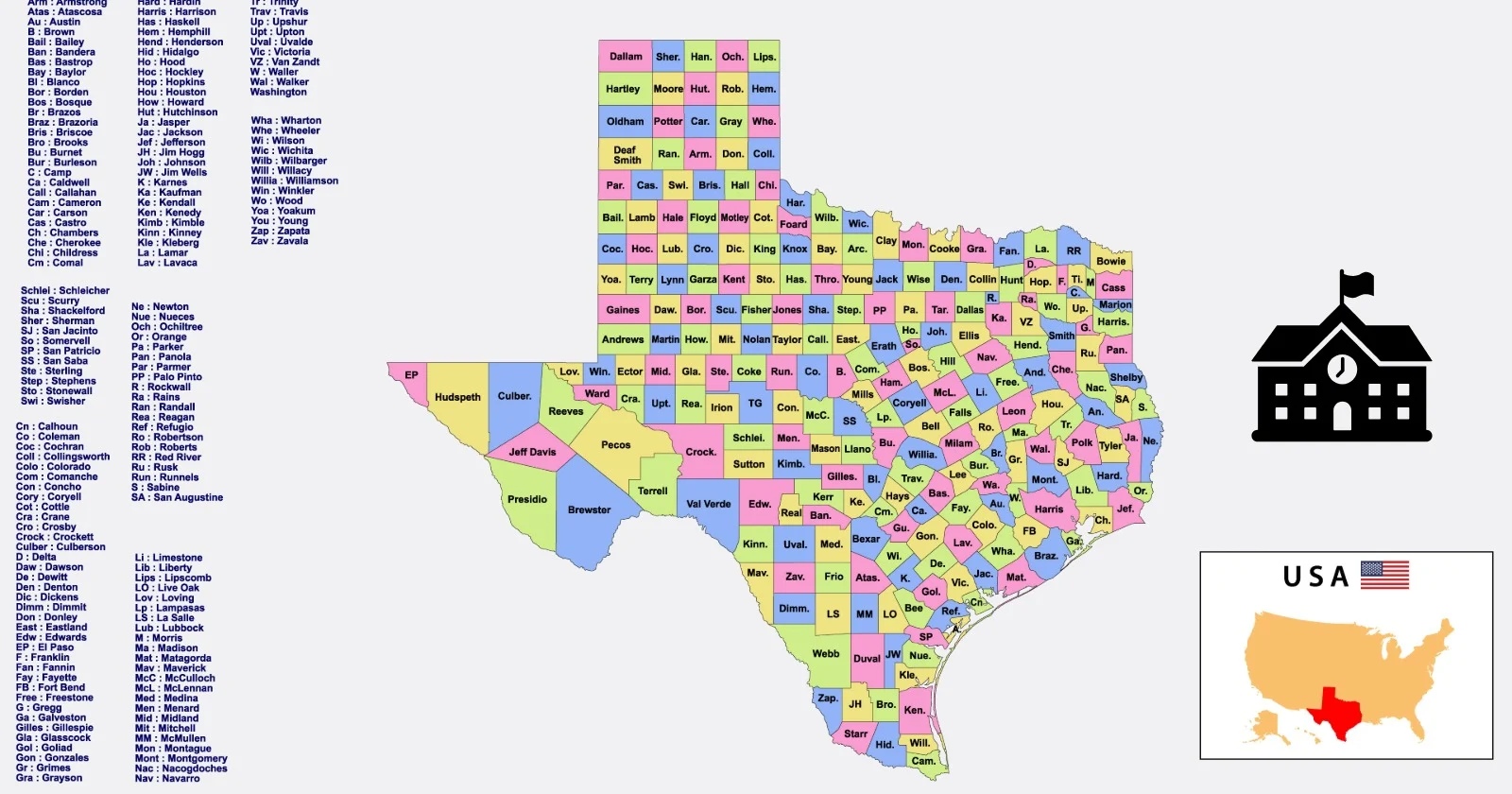
Texas has 9,601 public schools across 253 counties, which makes "which county has the best schools" a genuinely complex question rather than a simple ranking. The answer depends entirely on which part of the state you're in, what you're comparing against, and what you mean by best. Academic performance on state assessments is one measure. District resources, community investment, and the specific high school your child would attend are others. This breakdown covers the counties that consistently produce strong school outcomes, with enough specificity to actually be useful for families making housing decisions.
Collin County: The North Texas Standard-Setter
Collin County has a population of about 1.16 million and 316 public schools, and it has earned a reputation as the strongest large school county in North Texas over the past two decades. The major school districts operating here include Plano ISD, Allen ISD, Frisco ISD, McKinney ISD, Prosper ISD, and Wylie ISD, a lineup that represents some of the most closely watched districts in the state.
The county's academic profile is driven partly by demographics. Collin County has a high concentration of technology and finance employers along the US-75 and Dallas North Tollway corridors, which has attracted a highly educated workforce and created a tax base that funds schools well. The result is districts with strong per-pupil spending, competitive teacher compensation, and the facilities investment that tends to correlate with strong outcomes.
Allen High School in Allen with 5,317 students is the largest single high school in the county and one of the largest in Texas. Prosper High School in Prosper enrolls 3,769 students and has established itself as one of the top-performing schools in the state on STAAR assessments. Plano East Senior High School in Plano enrolls 3,082 students and carries a generational academic reputation that remains among the strongest in the county.
For families considering Collin County, the variation between districts is narrower than in most large Texas counties. Even the districts at the lower end of the county's performance spectrum, like Wylie ISD, outperform most of the state. Rent in the county's top cities reflects the premium: Frisco, Plano, and Allen are among the more expensive addresses in the DFW metro. McKinney and Wylie offer lower cost with comparable or near-comparable school quality.
Denton County: The Western Collin Counterpart
Denton County, with a population of about 980,000 and 247 public schools, sits immediately west of Collin and shares much of the same demographic profile. The major districts here include Lewisville ISD, Denton ISD, Northwest ISD, Little Elm ISD, and Argyle ISD.
Lewisville ISD is the largest district in the county and operates some of its strongest high schools. Flower Mound High School in Flower Mound enrolls 3,542 students and Marcus High School, also in Flower Mound, enrolls 3,005. Both are consistently strong performers and draw families specifically for those attendance zones. Hebron High School in Carrollton at 3,678 students serves the eastern part of the district.
Byron Nelson High School in Trophy Club, under Northwest ISD, enrolls 2,809 students and has developed one of the stronger academic reputations in northwest Tarrant and southern Denton counties. The planned community of Trophy Club produces a school with high parent investment and consistently strong outcomes.
Argyle ISD is worth mentioning specifically. It's a small district in the northern part of Denton County that consistently produces among the highest academic performance in Texas on a per-school basis. The community is predominantly affluent and the district benefits from the concentrated investment that comes with a small, tightly knit school population. It's not a realistic option for most families due to limited housing inventory, but it illustrates the kind of small-district outperformance that shows up in Denton County data.
Rent in Flower Mound and Lewisville is competitive with the Collin County top tier, and Denton County's position between Dallas and Fort Worth gives it commute flexibility that pure Collin County addresses don't offer.
Williamson County: The Austin Metro's Academic Anchor
Williamson County, north of Austin with a population of about 673,000 and 194 public schools, has emerged as the strongest school county in the Austin metro over the past decade. The major districts here are Round Rock ISD, Cedar Park ISD (part of Leander ISD), and Georgetown ISD, all of which have benefited from the tech-driven population growth that has transformed central Texas.
Round Rock ISD is the largest and most established district in the county. Round Rock High School in Round Rock enrolls 3,773 students and is consistently one of the top-performing large high schools in Central Texas on state assessments. Westwood High School, technically addressed in Austin but zoned to Round Rock ISD, is particularly well-regarded for STEM and college preparation and has attracted families specifically for its attendance zone.
Cedar Park and Leander, served by Leander ISD, have grown dramatically as tech workers priced out of Austin proper have moved north. Vista Ridge High School in Cedar Park enrolls 2,646 students and has a strong academic profile that reflects the demographics of the rapidly growing community it serves.
Rent in Round Rock and Cedar Park is significantly lower than comparable addresses in Austin proper, which has made Williamson County one of the more compelling value propositions in Texas for families who need proximity to Austin but want stronger schools at lower housing cost. Leander is lower still and feeds into the same Leander ISD system, making it the budget-friendly option within the same school district.
Montgomery County: The Woodlands Effect
Montgomery County, north of Houston with a population of about 684,000 and 144 public schools, owes much of its school reputation to a single community: The Woodlands. The master-planned development that began in the 1970s and grew into a city of over 100,000 has built a school infrastructure, primarily through Conroe ISD, that rivals anything in the Houston metro.
The Woodlands High School in The Woodlands enrolls 4,361 students, making it one of the largest high schools in Texas, and consistently ranks among the top public high schools in the state on academic metrics. College Park High School, also in The Woodlands, serves the newer western part of the community and has quickly established a comparable academic profile. Both schools benefit from a highly educated and economically invested parent community that has been a feature of The Woodlands since its founding.
Beyond The Woodlands, Conroe High School in Conroe enrolls 4,915 students, making it the second-largest high school in Texas by enrollment, but its academic profile is more mixed than the Woodlands schools and reflects a more economically diverse student population.
The county-level data for Montgomery County is somewhat misleading because of the concentration of strong outcomes in The Woodlands attendance zones versus more variable performance elsewhere in the county. Families who are drawn to Montgomery County for schools should verify specifically that they are zoned for a Woodlands school rather than assuming that a Montgomery County address means Woodlands-level school quality. Rent in The Woodlands reflects the premium; Conroe is meaningfully lower for families willing to accept the variation in school quality that comes with a different attendance zone.
Fort Bend County: Katy ISD and the Houston Southwest Corridor
Fort Bend County, southwest of Houston with a population of about 894,000 and 202 public schools, has developed one of the strongest school reputations in the Houston metro driven primarily by Katy ISD and Fort Bend ISD. The county has absorbed significant population growth as families have moved southwest of Houston seeking better schools and lower housing costs than comparable Harris County addresses.
Katy ISD operates several of the most consistently high-performing high schools in the Houston area. Cinco Ranch High School in Katy enrolls 3,656 students and has been one of the top academic performers in the county for over a decade. Seven Lakes High School, also in Katy, enrolls 3,595 students with a comparable academic profile and a particularly strong STEM and fine arts program. Tompkins High School at 2,908 students rounds out Katy ISD's strong high school lineup.
Fort Bend ISD serves the Sugar Land and Missouri City areas and has also built a strong academic reputation, particularly in the northern and more affluent parts of the district. The district has a large and academically oriented immigrant population, particularly in the Sugar Land corridor, that has driven AP participation rates and college placement outcomes well above state averages.
Rent in Katy and Sugar Land is lower than comparable addresses in Collin County, which makes Fort Bend County one of the better value propositions in Texas for families who need to be in the Houston metro and want strong schools without paying a premium comparable to the DFW top tier. Missouri City is lower still within the same Fort Bend ISD system.
Hays County: The Austin Metro Value Play
Hays County, south of Austin with a population of about 269,000 and 59 public schools, has grown faster than almost any county in Texas over the past decade and its school landscape reflects both the growth and the demographic diversity of the communities it serves.
Dripping Springs ISD is the standout district in the county. Dripping Springs High School in Dripping Springs enrolls 2,433 students and is consistently one of the highest-performing high schools in Central Texas on state assessments. The district serves a largely affluent community in the Hill Country west of Austin and benefits from high parent investment and strong community support. For families who can work remotely or whose jobs are on the southwest side of Austin, Dripping Springs offers school quality that competes with the Williamson County top tier at housing costs that, while not low, are below the premium of Westwood or Vista Ridge zones. Rent in Dripping Springs is not tracked separately on RentDataNow but the broader Dripping Springs area reflects a Hill Country premium that is still below equivalent suburban Austin addresses.
Kyle and Buda, served by Hays CISD, represent the faster-growing and more economically diverse part of the county. Schools here are solid without competing at the Dripping Springs level, and the housing costs in the Kyle-Buda corridor are among the most affordable in the Austin metro for families who need to stay within commuting range.
Comal County: Small County, Outsized Performance
Comal County, in the San Antonio metro with a population of about 184,000 and 47 public schools, punches well above its weight class academically for a county of its size. New Braunfels ISD and Comal ISD are the two main districts, and both have built strong reputations that draw families from San Antonio specifically for the schools.
Canyon High School in New Braunfels enrolls 2,348 students and is the largest school in the county. Smithson Valley High School in Spring Branch, serving the northern Comal County area, has an excellent academic reputation and draws families who want strong schools with a more rural Hill Country character than the suburban San Antonio corridor offers.
New Braunfels has grown significantly over the past decade as both San Antonio and Austin metro families have moved to the corridor between the two cities. Rent in New Braunfels is lower than comparable San Antonio northern suburbs, and the schools have historically outperformed what the price point would suggest. That gap has narrowed as the city's reputation has grown, but Comal County still represents better school quality per dollar than most of the San Antonio metro.
Galveston County: Clear Creek ISD and the South Houston Corridor
Galveston County, south of Houston with a population of about 359,000 and 93 public schools, is home to Clear Creek ISD, which has built one of the stronger school district reputations in the Houston metro. The district serves League City and the surrounding Clear Lake area.
Clear Falls High School in League City enrolls 2,473 students and is among the top academic performers in the district and the region. Friendswood High School in Friendswood enrolls 1,980 students and has consistently been one of the highest-rated smaller high schools in the Houston area, benefiting from a tightly knit community with high parent investment and a relatively affluent tax base.
The NASA Johnson Space Center influence on the Clear Lake area has historically produced a community with a higher concentration of engineers and scientists than typical suburban Houston, which has shaped the school culture and academic emphasis in ways that show up in outcomes. Rent in League City is lower than comparable addresses in The Woodlands or Katy, making Clear Creek ISD one of the better value propositions in the Houston metro for families who can commute from the south.
Brazos County: The College Station Exception
Brazos County, home to Texas A&M University with a population of about 242,000 and 53 public schools, is an outlier in this list because it makes sense primarily for families who are moving to the area for work or university affiliation rather than families choosing between Texas metros.
College Station ISD benefits directly from the university presence. College Station High School in College Station enrolls 2,134 students and is one of the top-performing high schools in the region, shaped by a parent community with an unusually high concentration of advanced degrees and an institutional culture that takes academic performance seriously. For families relocating to the Bryan-College Station area, College Station ISD attendance zones are worth specifically seeking out, and rent in College Station is significantly lower than comparable school quality in the major metros.
Rockwall County: Small, Consistent, and Underrated
Rockwall County, east of Dallas with a population of about 124,000 and 33 public schools, is the smallest county on this list and one of the most overlooked. Rockwall ISD is a compact district with a strong community identity and consistent academic performance that outperforms its size and reputation.
Rockwall High School enrolls 2,867 students and Rockwall-Heath High School in Heath enrolls 2,912 students, giving the district two comparably strong high schools. The two-high-school structure means less within-district variation than larger counties, and both schools consistently perform above state averages on STAAR assessments.
Rent in Rockwall and Heath is lower than Collin County top-tier addresses by a meaningful margin, and the school quality gap between Rockwall ISD and the Frisco-Plano-Allen tier is narrower than most people assume. For families whose commute can work from the east side of Dallas, Rockwall County represents one of the better school quality per dollar values in North Texas.
How Texas Measures School Performance
Texas uses the STAAR assessment system and assigns A through F accountability ratings to districts and schools based on student achievement, growth, and closing the gaps between student groups. These ratings are publicly available and searchable by district and school, making them a useful starting point for comparing schools within a county.
The ratings have real limitations. They measure what standardized assessments measure, which is a subset of what a school actually provides. A school with a B rating that has strong arts programming, a high-performing athletics culture, and deep community investment is not necessarily inferior to an A-rated school with lower extracurricular resources. The rating is a useful signal but not a complete picture.
County-level performance is also shaped heavily by demographics, which creates comparison problems. A county with a higher-income population and lower poverty rates will tend to have higher assessment scores regardless of school quality, because the research consistently shows that income and parental education are among the strongest predictors of student academic performance. The counties on this list generally have favorable demographic profiles, which is part of why their schools perform well, and families should interpret county-level rankings with that context in mind.
Browse schools by county and city across Texas on allk12 to see school profiles, enrollment numbers, and what parents and community members are actually saying on the discussion boards. For rent data by city across Texas, RentDataNow has current pricing so you can evaluate what the school quality premium costs in any market before you decide where to look.